

(Source)
(Alt-text: Steps to clean up poor website content )
Your website is one of your biggest digital assets, but not all content adds value to your business. Low-quality content, outdated, irrelevant, or poorly written, can hurt your SEO rankings, reduce engagement, and damage brand credibility.
Google’s algorithm prioritizes high-quality, user-focused content, and failing to meet these standards can lead to lower search visibility and fewer conversions. Content pruningthe process of removing low-performing pages, can significantly improve site performance and boost organic traffic.
But how do you know which content is helping and which is hurting your website? A thorough content audit can help identify and remove low-quality content, ensuring your site stays competitive in search results.
In this guide, we’ll cover:
✔ How bad content affects SEO rankings and website performance
✔ Steps to clean up poor website content efficiently
✔ Best practices for maintaining high content quality in 2025
If your website isn’t driving enough traffic, leads, or engagement, it may be time for a content cleanup.
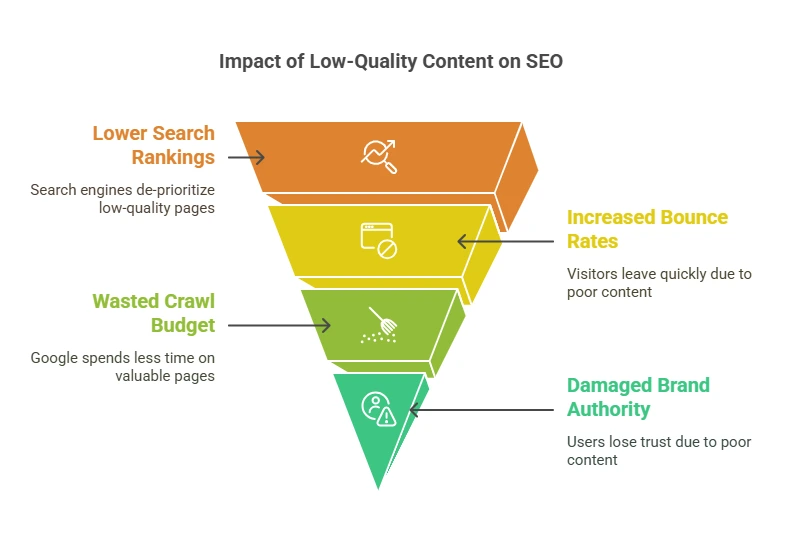
Many businesses focus on adding new content, but they often overlook the impact of outdated, thin, or poorly optimized pages. Google’s Helpful Content Update emphasizes valuable, relevant, and user-focused content, meaning that low-quality pages can actually pull down your entire website’s SEO performance.
Search engines favor useful, engaging, and well-structured content. Pages with thin content, duplicate information, or overused keywords get de-prioritized, leading to a drop in organic traffic.
Visitors expect clear, relevant, and engaging content. If they land on a page that lacks value, they leave quickly, sending negative user signals to Google. High bounce rates tell search engines that your content isn’t meeting user intent, impacting rankings.
Google allocates a crawl budget to every site, meaning it only crawls a limited number of pages. If your site is cluttered with thin, outdated, or irrelevant pages, it reduces the chances of ranking high-value content.
Users associate poor content with poor credibility. If your website has inaccurate information, outdated insights, or weak readability, visitors won’t engage or convert.
By removing low-quality content and optimizing valuable pages, businesses can improve user experience, SEO rankings, and conversion rates.
|
Read: The Complete Guide to Conducting a Technical SEO Audit |
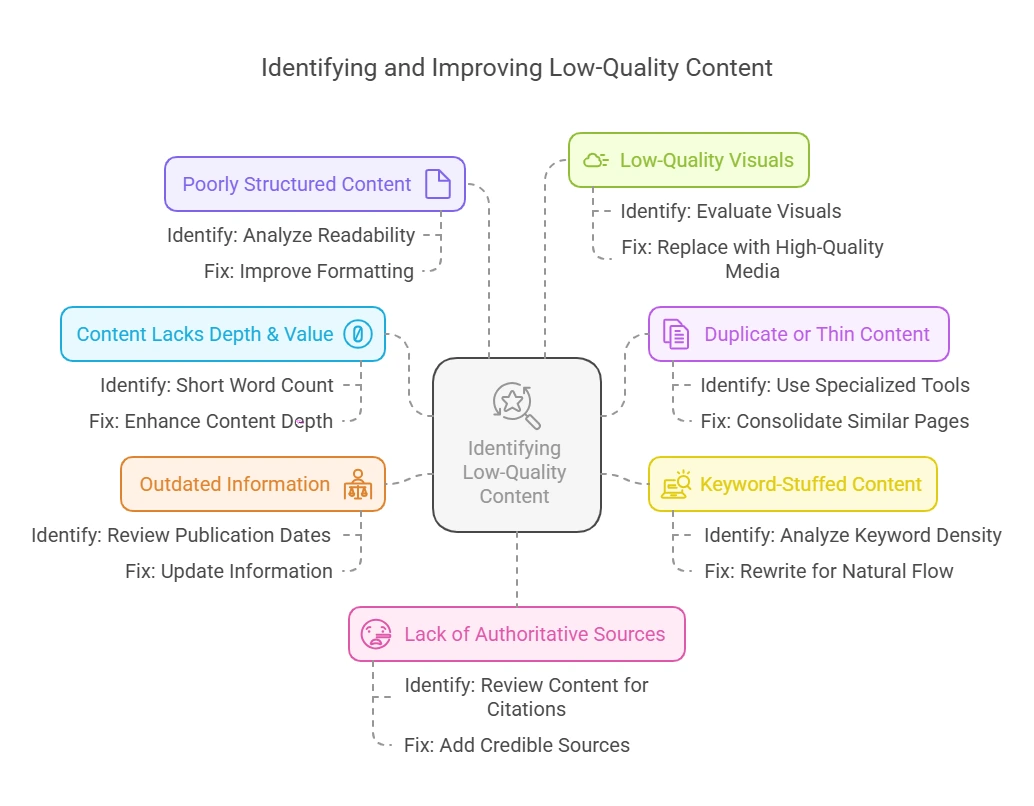
Detecting subpar content is crucial for maintaining your website's integrity and search engine ranking. Below are key indicators and methods to identify content that may be detrimental to your site's success.
Why It’s a Problem: Superficial content fails to engage readers or provide meaningful insights, leading to decreased user satisfaction and higher bounce rates.
How to Identify:
How to Fix:
Why It’s a Problem: Duplicate content can confuse search engines, leading to potential ranking penalties, while thin content offers little value to users.
How to Identify:
How to Fix:
Why It’s a Problem: Overusing keywords can make content sound unnatural and may lead to search engine penalties for keyword stuffing.
How to Identify:
How to Fix:
By systematically addressing these aspects, you can significantly improve your website's content quality, leading to better user engagement and enhanced SEO performance.
Why It’s a Problem: Outdated or irrelevant content can mislead visitors, diminish trust, and negatively impact your site's credibility.
How to Identify:
How to Fix:
Why It’s a Problem: Content that lacks clear structure can be difficult to read and understand, leading to decreased user engagement and higher bounce rates.
How to Identify:
How to Fix:
Why It’s a Problem: Poor-quality images or videos can detract from user experience and make your site appear unprofessional.
How to Identify:
How to Fix:
Why It’s a Problem: Content that lacks credible sources or citations can appear untrustworthy and may not rank well in search engines.
How to Identify:
How to Fix:
Addressing these aspects systemically can significantly improve your website's content quality, leading to better user engagement and enhanced SEO performance.
Once you’ve identified low-quality content, the next step is to prune, update, or optimize it. A strategic content audit helps ensure your website is clean, authoritative, and optimized for SEO and conversions. Here’s how you can effectively clean up poor website content and improve your site's performance.
A content audit is the foundation of any successful content cleanup strategy. It involves analyzing all pages on your website to determine which should be kept, improved, consolidated, or deleted.
By conducting a detailed audit, you gain data-driven insights into which content is helping and which is hurting your website’s performance.
Some pages may no longer be relevant or actively harming your SEO rankings. Instead of keeping outdated, redundant, or irrelevant content, consider the following options:
Pruning dead-weight content improves crawl efficiency, ensuring search engines prioritize your most valuable pages.
Not all content needs to be deleted, many pages simply need optimization. Instead of removing low-performing pages, consider updating and improving them with:
This process strengthens your content strategy, making old pages relevant again while boosting SEO rankings.
At LexiConn, we specialize in helping businesses identify and remove low-quality content that negatively impacts their SEO, engagement, and lead generation. Our data-driven content audit services ensure that your website remains relevant, high-performing, and search engine friendly.
✔ SEO Content Analysis – Identify content gaps, duplicate pages, and low-performing assets.
✔ Content Pruning & Cleanup – Remove outdated, irrelevant, and poorly optimized content.
✔ Content Optimization & Rewriting – Enhance underperforming pages with fresh insights and improved readability.
✔ Technical SEO Fixes – Improve crawlability, indexing, and overall website health.
🔹 Proven expertise in website audits, SEO, and content strategy.
🔹 Tailored solutions that align with your industry and business objectives.
🔹 Actionable recommendations that increase rankings, traffic, and engagement.
LexiConn also offers a free 30-minute content consultation session to help you with your website auditing and content strategy.
96.55% of online content gets zero organic traffic from Google. That’s because most websites are cluttered with outdated, thin, or low-value content that fails to engage users or rank in search results. Simply put, if you don't remove low-quality content, you could lose valuable traffic, leads, and credibility without realizing it.
By regularly auditing, removing, and optimizing low-quality content, businesses can:
✔ Improve search engine rankings with valuable, high-quality content.
✔ Enhance user engagement by offering better readability and relevance.
✔ Boost lead generation by ensuring visitors find trustworthy, actionable insights.
Google prioritizes websites that offer real valueis your content meeting those expectations? If not, it’s time for a strategic content cleanup.
Schedule a FREE content audit consultation with LexiConn today and take the first step toward a cleaner, stronger, and more profitable website. Visitwww.lexiconn.in or emailbook a free consultation to get started.
Remember: If your content isn’t delivering the expected results, it’s time for a strategic cleanup. A professional website audit can uncover hidden content issues, improve rankings, and unlock your site’s potential. Let’s make sure your website works for you, not against you.

I have read and accept the Privacy Policy
Read More