
White paper writing services
for technical B2B buyers,
built to be forwarded.
LexiConn is a B2B content agency in Mumbai, founded in 2009. We write research-backed white papers for technology (including healthcare technology) and financial services companies: from your experts and your data, with every claim traced to a source and checked by an editor.
Brands that trust LexiConn for B2B white papers







Four kinds of white paper.
Technical, research, position and policy papers, each one signed off by an editor.

Technical white papers
How a technology works and why it matters, written from interviews with your engineers.
Technology content ›
Research and survey papers
Findings from your data, with every figure traced back to the slide or table it came from.
Report writing ›
Problem-solution and thought leadership papers
One position, argued from evidence, for the people who decide.
Thought leadership ›
Regulation and policy papers
What a new rule means for your customers and your industry, checked against the regulator's own text.
Financial services content ›White papers we have written.
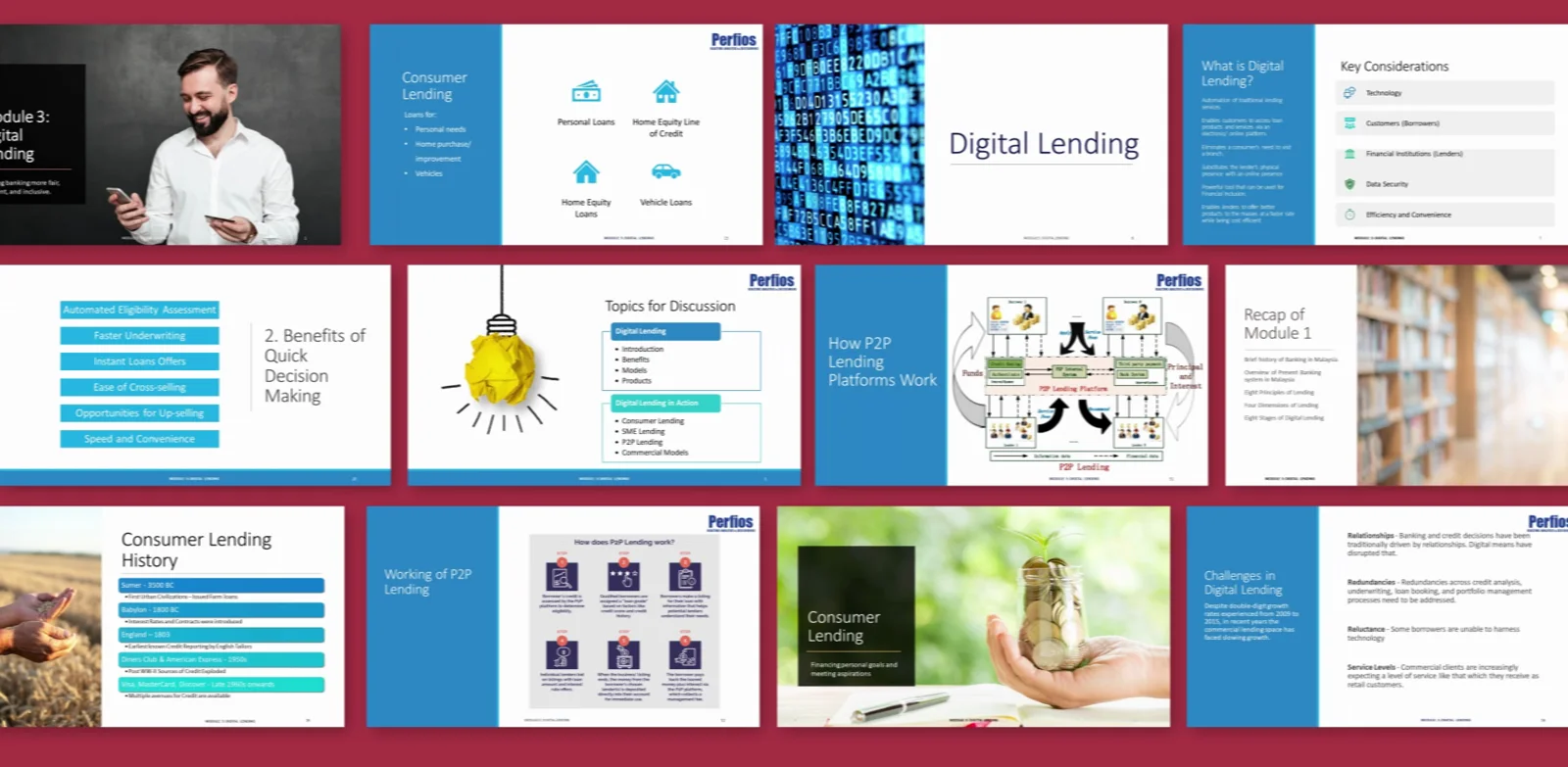
For healthcare technology, HR, research, financial data and industrial companies.




The same research discipline runs through our thought-leadership work. For Nuvama Wealth, as its exclusive content partner, we wrote a fixed 11,000 words of articles a month, and pieces from the work ran on Moneycontrol, Forbes Advisor, Jagran and ET. Read the Nuvama case study.
A white paper has one job.
To be forwarded to someone who was not in the meeting, and to survive being read by them without you there to explain it.
That rules out most of what gets called a white paper. A long brochure does not survive it. Neither does a summary of things the reader already knows. What survives is original analysis, stated with its method visible, so a technical reader can check the reasoning rather than take it on trust.
This white paper introduces ABC company’s new freight service.
Purdue’s own example. Write about the reader’s problem: how to choose a freight service.
Studies show most CIOs plan to switch platforms.
Which study, which year, how many CIOs? Cite it where you use it.
Buyers are shifting to guaranteed plans.
The data shows how common they are, not a shift. Say what it shows.
The first line is the example Purdue OWL uses. The other two are illustrative; the third is a mistake we caught in our own research for an insurer.
“It is important to emphasize your readers’ interests rather than your interests.”Purdue Online Writing Lab, on white papers. It defines the purpose of a white paper as advocating that a certain position, or a certain solution to a problem, is the best way to go.
Evidence first. Then the argument.
We write these with subject-matter interviews, primary sources cited inline, and an editorial pass whose specific job is to find the claim that cannot be supported. If the research does not say what the brief hoped it would say, we tell you before it is written, not after.
Source audit before writing
We read your deck, survey or reports end to end before the outline, and list every gap, conflict and weak claim, with a question for each.
Survey white paper commissioned by a global research agency, 2026A data bank with a source under every figure
Every figure goes into a data bank with its source link before it goes into a sentence. When one fails, it comes out: an education-inflation figure traced back to a competitor’s blog, and official CPI data put it at 3.32% (MoSPI CPI release, December 2025).
Run three times for a life insurer in 2026- IRDAI Disclaimer missing next to the claim
- Brand Term outside the approved style
Brand Guard, for regulated papers
For banks and insurers, our own tool flags misses against your brand guidelines and IRDAI, ASCI and DPDP rules, so writers, brand teams and compliance see the same issues at the same time.
Built by LexiConn AI. Ask us for a demo.How a white paper gets built.
AI does the assembly: it reads source decks and transcripts and flags every claim that needs a source. People own the argument, the interviews, the numbers and the sign-off.
- Define the briefThe reader, the question the paper must answer, its use, and the evidence available.
- Build the evidence baseA source plan and expert interviews. Every useful claim recorded with its source.
- Approve the structureEach section gets a purpose, a point and the evidence for it, checked by an editor and your expert.
- Draft and editSources cited as claims are written. Unsupported claims and sales language go back.
- Expert and client reviewTerminology, facts and compliance checked. Comments merged into one set of decisions.
- Design and check the final proofWe design it too: layouts, charts and infographics in your brand. Citations, tables and figures are checked again on the designed proof.
Read the full process
1. Define the brief
The work begins with a brief that defines the reader, the question the paper must answer, the intended use, and the evidence available. The account lead checks whether the scope is specific enough to research. If the brief combines unrelated questions, assumes an unsupported conclusion, or does not identify the reader, it goes back for clarification before research starts.
2. Build the evidence base
The researcher then builds a source plan. This covers primary documents, reputable secondary sources, internal material, and subject-matter interviews. Each useful claim is recorded with its source so the writer can trace it later. Weak, outdated, or contradictory evidence is flagged rather than worked around. If the available research does not support the proposed argument, the team raises that gap before an outline is approved.
3. Approve the structure
The writer turns the evidence into a section-by-section outline. Each section must have a purpose, a supporting point, and the evidence needed to make that point. The editor checks the logic, balance, and order. Subject-matter reviewers check whether the proposed argument reflects the field accurately. Outlines are usually sent back when they read like a long brochure, repeat the same point under several headings, or move from evidence to conclusion too quickly.
4. Draft and edit
Once the outline is approved, the writer prepares the draft. Sources are cited as claims are written, not added from memory at the end. Tables, examples, and proposed visuals are marked in context. The first editorial review checks whether the paper answers the brief, explains technical ideas clearly, and distinguishes evidence from interpretation. Unsupported claims, vague authority language, hidden assumptions, and sections that promote rather than analyse are returned for revision.
5. Run expert and client review
The revised draft then goes to the relevant subject-matter and client reviewers. They verify terminology, technical accuracy, internal facts, and any statements based on interviews. Legal or compliance review is included where the subject requires it. Review comments are consolidated so the writer receives one clear set of decisions rather than conflicting instructions from several documents.
6. Check the final format
After revisions, a final quality check covers citations, headings, tables, references, terminology, grammar, and consistency. If design is part of the assignment, the approved copy is handed over with a clear content hierarchy and notes for charts or diagrams. The designed proof is checked again for missing text, altered figures, broken references, and layout choices that separate a claim from its qualification. Delivery happens only after the content and final format match the approved version.
Original research,
with the method on the page.
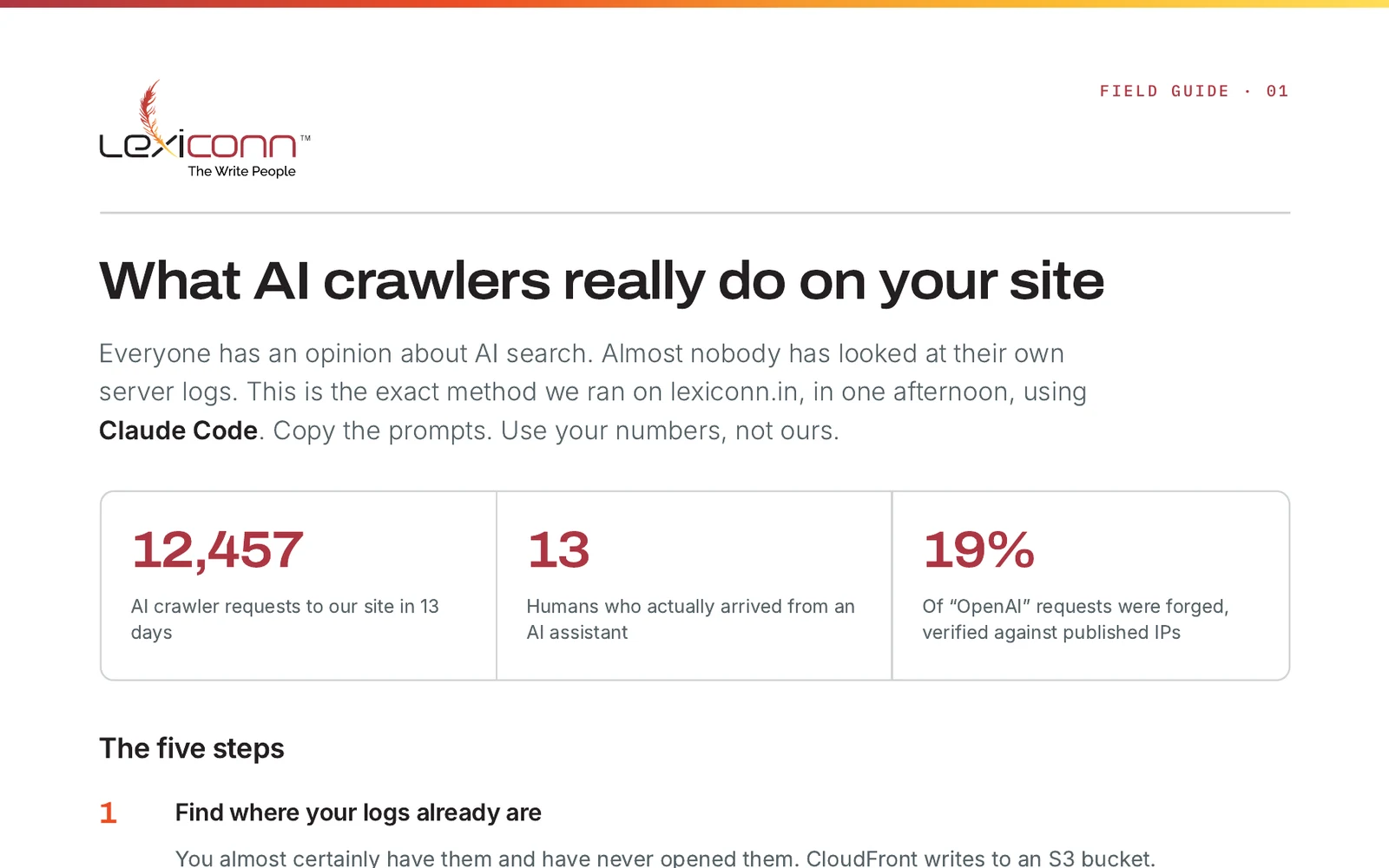
We hold our own research to the same standard. For our field guide on AI crawlers, we read 13 days of lexiconn.in server logs: 12,457 AI crawler requests. Then we checked every request that claimed to come from OpenAI against the IP ranges OpenAI publishes.
19% of them were forged. For GPTBot alone it was 48%. The guide prints each step, so a reader can run the same check on their own site and get their own numbers.
Writers who ask
for the source.
We do not pretend to be engineers. Domain accuracy comes from a process: we interview your subject-matter experts, work from your source documents and conversations, and send technical pieces back to an expert on your side for sign-off. Specialist subjects such as switchgear, data centres, capital markets or clinical content bring in subject experts we have worked with before, under the same editor.
LexiConn was founded in 2009. See how we work.
What should your white paper do?
Pick a goal to see the types of white paper we write for it.
Explain a technology. For evaluators and the engineers who will live with the choice.
Argue a position. For the people who decide, and the colleagues they forward it to.
Publish research. For readers who want numbers they can quote and check.
Explain a rule or policy. For customers, staff or an industry adjusting to a change.
Need numbers rather than an argument? See report writing. Need proof from one client? See case study writing. Not sure which? Start with a content audit.
Questions about white paper writing.
Are white papers peer reviewed?
No. A white paper is published by a company, government body or institution, not by an academic journal, so no outside panel of scholars reviews it. University libraries file white papers under grey literature for that reason. What stands in for peer review is the process: every claim traced to a cited source, an editor whose job is to find the claim that cannot be supported, and sign-off from a subject expert on your side.
What is the difference between a white paper and a research paper?
A research paper is written for other researchers. It reports a study, goes through peer review and argues for no product or company. A white paper is written for decision-makers. It uses research to argue that one position, or one solution to a problem, is the best way to go. A good white paper shows its method and cites its sources inline, so a technical reader can check the reasoning instead of taking it on trust.
Can you write a white paper from our own survey or data?
Yes, and we audit the data before we write. For one survey white paper commissioned in 2026, to be written only from a 111-slide survey deck, the audit found 22 places where a summary slide disagreed with its own chart or table, 6 blockers and 12 framing risks. We sent 11 written queries, then wrote the white paper: front matter and 10 chapters, about 10,580 words under an 11,000-word cap, with a slide marker on every figure.
Do you interview our subject experts?
Yes. We do not pretend to be engineers, actuaries or doctors. We interview your experts, work from your source documents, and send technical sections back to an expert on your side for sign-off before publication. For specialist subjects we bring in subject experts we have worked with before, under the same editor.
How long does a white paper take?
It depends on length and on how ready your evidence is. One white paper of about 5,000 words, on agentic AI in HR, went from brief to delivery in two to three weeks with a writer and an editor. Writing is rarely the slow part: the brief, the research and time with your experts are. We agree dates for the outline, the first draft and each review round at the start, and send drafts back section by section so a change of direction shows up early.
How do you use AI on a white paper?
AI reads and summarises source decks, reports and transcripts, builds the first outline and flags every claim that needs a source. People decide what the paper argues, run the expert interviews, write the sentences that carry the argument, check every number and sign off. Nothing reaches you that a person has not read line by line.
On peer review: the University of Leeds library lists white papers as grey literature, which it notes is not peer reviewed.
More questions about white papers
What is the process for white paper writing?
LexiConn follows a structured process: consultation, research, outline development, content creation, and revisions. Each paper is written for one defined reader and argues one position from evidence.
How do I order white paper writing services?
You can start by booking a 30-minute call. On the call we agree the reader, the question and the evidence. Research, drafting, review rounds and design follow.
How can a high-quality white paper build my business brand?
A well-written white paper establishes brand authority by addressing complex industry issues with data-backed insights and expert analysis. We write it from your experts and your data, with every claim traced to a source.
Why should I consider professional white paper writers?
Professional writers do the research and turn complex ideas into a paper a decision-maker can follow. Your experts give us interviews and a review, not weeks of writing.
What if I don’t have a content structure for my white paper?
LexiConn creates a detailed outline based on your goals, audience, and industry research when no existing structure is available. The outline lists each section, the evidence it needs and where a case study fits.
Do you provide design services for white papers?
Yes, LexiConn's white paper service includes professional design with custom layouts, charts, and infographics. We design it in your brand, for screen and for print.
What makes white paper writing services in India a top choice?
Agencies in India combine subject knowledge, fluent English and competitive pricing. LexiConn writes white papers for business readers in India and abroad.
What is a famous example of a white paper?
A well-known white paper is the Bitcoin Whitepaper by Satoshi Nakamoto, published in 2008. This white paper introduced the concept of a decentralized digital currency, laying the foundation for Bitcoin and blockchain technology. It is often cited as one of the most influential white papers on digital currency.
How do white paper writing services help with lead generation?
White papers generate leads by offering in-depth, valuable analysis that prospects willingly exchange their contact information to access. LexiConn creates gated white papers that tackle industry challenges, propose solutions, and guide readers through the buyer’s journey toward your offering.



Start small. Then scale.
One-off white papers solve this month. A content engine solves the year. Start with one paper, and the same sources, interviews and data bank can feed articles, LinkedIn posts and sales material after it.
Or get a paid pilot page for your white paper