
Social media has become a crucial marketing platform, but with millions of businesses fighting for consumers' attention, standing out is more challenging than ever. Artificial Intelligence (AI) has emerged as a powerful force, driving innovation in the way businesses interact with their audiences. AI tools are enhancing social media branding, enabling businesses to create personalized, engaging experiences for their target customers.

In this blog, we’ll explore the role of AI in transforming social media branding, discuss how social media automation is improving business efficiency, and introduce the best AI tools for social media marketing. We’ll also examine the future of AI in social media and how businesses can leverage it to create more impactful branding strategies. To ensure AI-powered efforts are anchored in a strong overall plan, read our guide on mastering social media strategy for digital engagement. Our seven tips for writing an effective social media content strategy also help you build the human-led foundation that AI tools can then amplify. To understand what makes content go viral and spread organically, our analysis of the science behind viral social media campaigns offers valuable perspective.
Businesses, regardless of size, are increasingly relying on AI to streamline their social media strategies. AI enables brands to automate tasks, analyze data, and create highly tailored content strategies. Here’s why AI has become indispensable for social media branding:
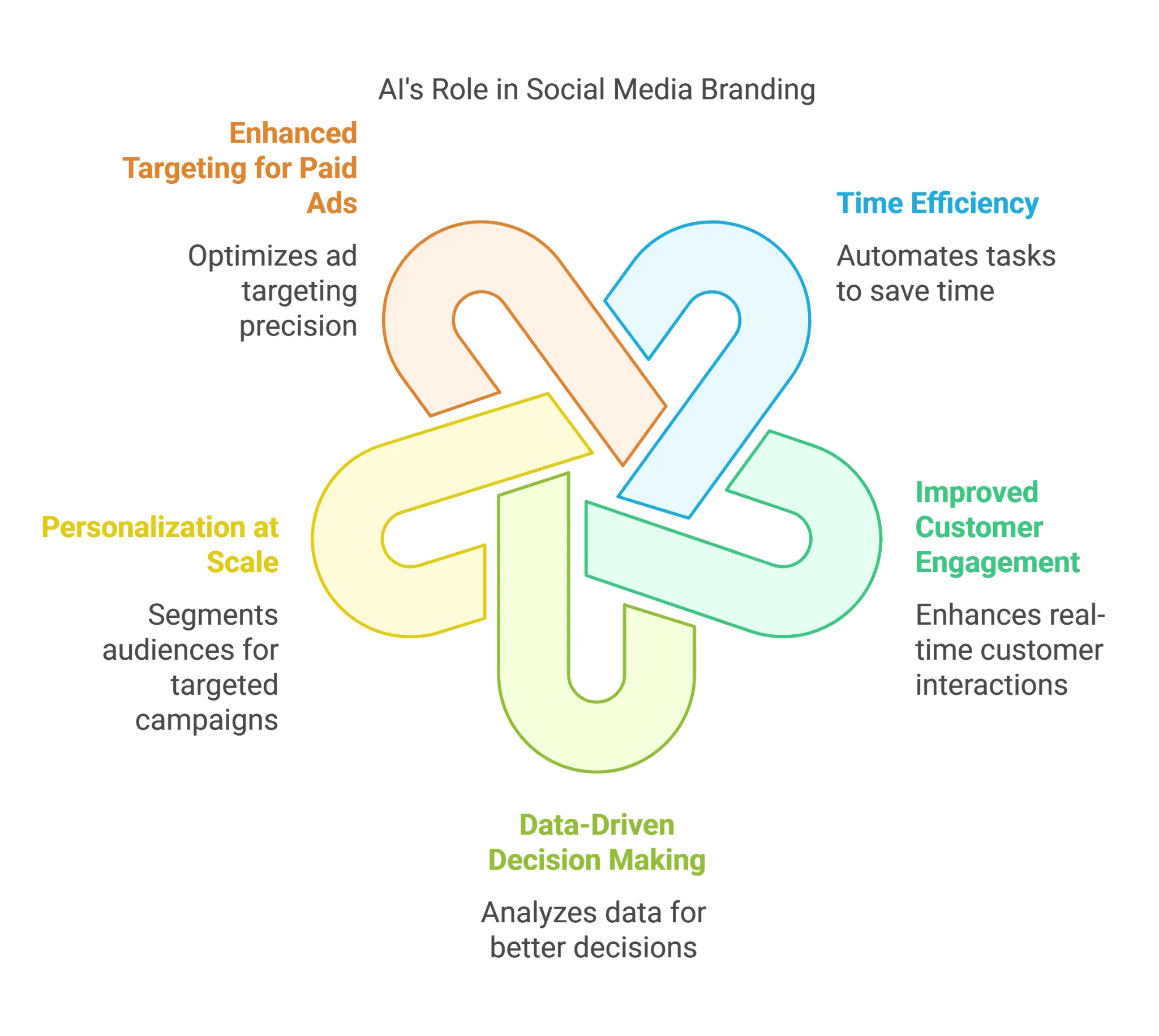
Social media content is at the heart of any branding strategy. Creating compelling content that resonates with your audience is essential for engagement. AI tools are transforming content creation by making it faster, more efficient, and more personalized. Here’s how:
Content creation can be time-consuming. However, AI-powered tools like Copy.ai and Writesonic are enabling businesses to generate high-quality content in seconds. These tools use advanced algorithms to create text-based content, such as blog posts, captions, and product descriptions, tailored to your brand’s voice.
Additionally, AI tools like Frase.io help businesses generate content ideas by analyzing high-ranking pages on a given topic and suggesting the most relevant keywords and topics to cover.
AI tools also assist in creating visually appealing content for social media. Platforms like Canva and Crello use AI to suggest design templates, color schemes, and layout structures that match your brand’s identity. These platforms streamline the process of creating eye-catching graphics and infographics, saving businesses both time and effort.
AI in visual content creation also extends to video editing. Lumen5 allows businesses to convert blog posts into engaging social media videos, using AI to match video content with the most relevant text, music, and images.
Image recognition is another area where AI is making waves. Tools like Google Vision AI can identify objects, scenes, and even emotions in images. This helps businesses optimize their social media posts by ensuring that their visual content resonates with their target audience.
AI tools can also help with content curation, ensuring that businesses share relevant, high-quality content with their followers. Platforms like Curata use AI to analyze trends and identify content that aligns with your brand’s niche. This eliminates the need for businesses to manually curate content, saving time and ensuring that their social media feed is always fresh and engaging.
Branding is more than just a logo or tagline. It’s about creating a consistent, memorable experience for your audience. AI is transforming how businesses build and maintain their brand on social media.
AI can help businesses personalize their branding efforts on social media by analyzing user data and providing insights into what types of content are most engaging. By tracking engagement patterns, businesses can understand their audience's preferences and create content that speaks directly to them.
Personalized content fosters deeper connections with your audience, increasing brand loyalty. For example, Netflix uses AI to recommend content based on user behavior, keeping viewers engaged and satisfied with personalized suggestions.
Social listening involves monitoring social media platforms for mentions of your brand, competitors, and industry trends. AI tools like Brandwatch and Mention analyze social conversations to help businesses understand public sentiment toward their brand. These tools provide real-time data on how people feel about your brand, enabling businesses to adjust their messaging accordingly.
Using AI-driven social listening, businesses can track shifts in consumer sentiment, identify potential crises, and capitalize on positive feedback to enhance their brand image.
Influencer marketing has become a powerful branding tool, but identifying the right influencers can be a time-consuming task. AI simplifies this by analyzing vast amounts of social data to identify influencers whose followers align with your target audience. Tools like Upfluence and Traackr use AI to recommend influencers based on factors like engagement rates, audience demographics, and content relevance.
By leveraging AI in influencer marketing, businesses can build authentic partnerships that enhance their brand credibility.
One of the most significant advantages of AI in social media is automation. Automation allows businesses to save time while maintaining consistency and optimizing engagement across multiple platforms.
AI-powered scheduling tools like Hootsuite, Buffer, and SocialBee help businesses schedule posts across multiple platforms in advance. These tools use AI to determine the optimal times for posting based on user activity, ensuring maximum visibility and engagement.
AI-powered chatbots are revolutionizing how businesses interact with their audience on social media. Chatbots like ManyChat and MobileMonkey can answer customer questions, provide product recommendations, and even process transactions without human intervention. By offering instant responses, businesses can keep their customers engaged and satisfied.

AI tools for social media analytics help businesses track their performance in real time. Tools like Sprout Social and Zoho Social provide in-depth insights into engagement metrics, allowing businesses to optimize their content strategy on the fly. AI-driven analytics can identify trends, suggest improvements, and predict future engagement patterns.
AI tools have become essential for social media marketing, offering businesses the ability to automate tasks, track performance, and create personalized content. Here are some of the best AI tools for social media marketing:
Hootsuite is a comprehensive social media management platform that allows businesses to automate social media posting, monitor mentions, and analyze performance. With AI-driven insights, Hootsuite helps businesses optimize their campaigns by suggesting improvements based on data.
Buffer is another popular social media management tool that helps businesses schedule posts, track analytics, and analyze engagement. Its AI-powered features help businesses maximize their social media reach and improve performance.
Sprout Social is an AI-powered social media management tool that offers in-depth analytics, social listening, and engagement features. It helps businesses track brand sentiment, measure engagement, and optimize their content strategies.
Canva
Canva is a design tool that uses AI to suggest design elements, layouts, and templates for social media posts. It simplifies the process of creating visually appealing content, making it easy for businesses to maintain a consistent brand presence.
Chatfuel is an AI-powered chatbot platform that allows businesses to automate interactions with their audience on platforms like Facebook Messenger and Instagram. Chatbots can answer questions, provide recommendations, and drive engagement, all while operating 24/7.
Lately is an AI-driven content creation tool that helps businesses turn long-form content into short, engaging social media posts. It analyzes engagement data to create high-performing posts, saving businesses time while ensuring their content resonates with their audience.
AI is enhancing engagement on social media by not only automating responses but also making interactions more personalized and data-driven.
By analyzing vast amounts of data and user behaviors, AI helps businesses craft tailored experiences. This ensures that content resonates with their audience, fostering greater interaction and connection.
Here’s how AI is supercharging engagement:
AI-powered chatbots have become the cornerstone of modern customer service, providing businesses with the ability to support their customers around the clock.
Whether a customer needs help with a product, service, or inquiry, chatbots like ManyChat and Drift respond instantly, addressing concerns without delays. This immediate response is crucial for retaining customer interest, especially when social media users expect fast answers.
Additionally, AI chatbots can handle an increasing volume of inquiries, ensuring no customer is left waiting. For businesses, this reduces the burden on human customer service teams and allows resources to be focused on more complex tasks.
Over time, chatbots also learn from interactions, becoming more effective at answering questions and resolving issues, creating a smoother customer experience.
Personalization is at the heart of AI’s ability to increase engagement. AI tools collect data from user interactions, track behavior, and analyze preferences to deliver tailored content. This could range from personalized product recommendations to individualized marketing messages that speak directly to a user's needs and desires.
For example, AI can analyze browsing history or past purchase behavior to suggest content or products users are more likely to engage with. Amazon’s recommendation engine, powered by AI, is an excellent example of how personalization enhances the user experience.
By presenting users with relevant products or content, businesses can keep their audience engaged, improve click-through rates, and increase conversions.
AI also enables hyper-targeted advertising. Rather than relying on broad assumptions, AI tools segment users into highly refined groups, allowing businesses to target specific demographics with content that speaks to their exact interests.
This targeted approach leads to higher engagement rates, as users are more likely to respond to content that feels relevant to their needs.
Predictive analytics is another area where AI excels. By analyzing historical data, AI tools can predict future engagement trends. For example, AI can identify content that is likely to perform well and predict which types of posts will resonate with your audience.
Additionally, AI can suggest the best times to post for maximum engagement. These insights help businesses fine-tune their social media strategy. AI tools like Sprout Social and HubSpot use predictive analytics to analyze social media interactions and suggest adjustments in real time.
These platforms look at metrics such as past engagement rates, peak activity times, and trending topics to recommend what content businesses should post and when.
Furthermore, predictive analytics can forecast which content will be popular in the future. For example, AI can track emerging trends, analyze user conversations, and help brands get ahead of the curve by creating relevant content before it becomes mainstream.
This keeps businesses at the forefront of consumer interests and enhances their ability to engage with followers.
AI isn't just limited to engagement automation or customer support. It also plays a crucial role in content creation. By analyzing trends and engagement patterns, AI can help businesses generate dynamic content that resonates with their audience. AI-powered tools like Lately.ai can transform long-form content (e.g., blog posts, whitepapers) into smaller, bite-sized social media posts that are optimized for sharing and engagement.
AI tools help businesses create content tailored to user preferences by recommending specific images, keywords, and hashtags. These recommendations enhance the visibility of posts, making them more likely to reach the right audience.
Tools like BuzzSumo use AI to track the most shared content in any given industry, helping businesses identify topics that are gaining traction and tailoring their content to tap into these trends.
AI’s ability to gauge emotions and sentiment plays a significant role in improving engagement. AI-powered sentiment analysis tools, like MonkeyLearn and Lexalytics, can analyze the tone of social media posts, comments, and messages, allowing businesses to understand how their audience feels about their brand.
This can help businesses tailor their engagement approach, addressing negative sentiments promptly or amplifying positive feedback.
For example, if a customer expresses frustration in a social media post, AI can alert the business to respond in a timely manner, reducing the likelihood of negative reviews or customer churn.
By analyzing emotional responses, businesses can craft content that resonates more deeply with their audience. This emotional connection increases the chances of higher engagement, shares, and comments.
AI-powered automation takes engagement to the next level by not just providing instant responses but also crafting contextually relevant ones. AI tools like Chatfuel or MobileMonkey can engage with users based on the context of their query.
Whether the interaction is about a product inquiry, a customer complaint, or a simple follow-up message, AI can craft responses that are not just generic but tailored to the specific needs of the conversation.
This level of contextual intelligence helps build trust and ensures customers feel understood, improving their overall engagement with the brand.
If a user inquires about a discount on a product, the AI can recognize the context of the question and provide the relevant details. Additionally, it can suggest other products the user may be interested in, further driving engagement.
Video content is one of the most engaging forms of content on social media, and AI tools are enhancing this medium too. AI can be used to analyze engagement data from video posts and adjust content to improve performance.
Platforms like Wibbitz use AI to help brands create engaging short-form videos from existing long-form content, making it easier for businesses to repurpose content and maximize its impact.

AI also enhances video interaction by enabling real-time captioning and translation, which increases accessibility and engagement across different linguistic audiences.
Additionally, AI-driven video optimization tools can adjust video length, style, and format based on platform-specific trends, ensuring the content is perfectly tailored for maximum viewer retention.
At LexiConn, we specialize in helping businesses unlock the full potential of AI to elevate their social media strategies. Whether it's refining your content, enhancing engagement, or implementing AI-driven automation, our team of experts is here to guide you every step of the way.
We tailor solutions that align with your unique business needs, ensuring you stay ahead in the competitive digital landscape.
AI is changing the landscape of social media branding, offering businesses the ability to automate tasks, personalize content, and optimize their engagement strategies. By leveraging AI tools for social media automation, content creation, and audience targeting, businesses can improve their social media branding efforts and stay competitive in an ever-evolving digital space.
To learn more about how AI can enhance your social media strategy, book a free consultation with LexiConn today. Our team of experts will help you harness the power of AI for your business.
I have read and accept the Privacy Policy
Read More