
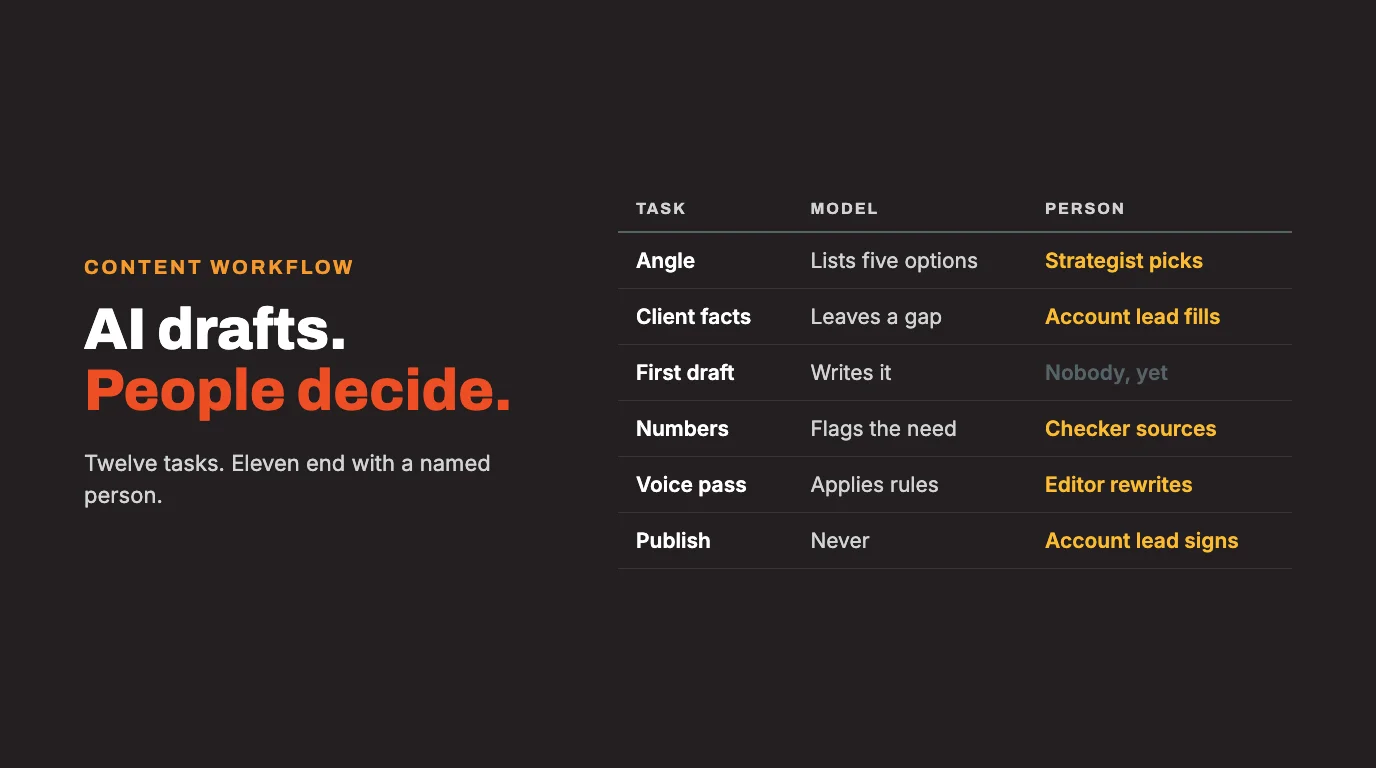
What AI drafts well and what it never decides: a task split table
The split is simple: AI produces text, people make decisions. Every task in a content workflow falls on one side of that line, and most teams have never written the line down.
This article is the line, written down. It is our table for assigning each step to a model or to a named person.
Why a written split matters
Without a written split, the model does whatever the fastest person lets it do, which on a busy day includes choosing the angle and on a quiet day includes nothing at all.
Both are wrong. The angle is a decision, while formatting a reference list is not, and a table fixes that boundary so it does not move with the workload.
Jasper's 2026 survey of 1,400 marketers found governance had become their biggest challenge, with a 3.4x year-over-year increase in blockers from legal, compliance and brand review. The survey report has the trend. A task split is governance you can print.
The table
| Task | Model drafts | Person decides | Why |
|---|---|---|---|
| Choosing the angle | Lists five options | Strategist picks one or rejects all | The angle is the claim. A claim needs an owner. |
| Research summary | Summarises supplied sources | Checker confirms every figure against the original | Models paraphrase badly and invent well. |
| Outline | Proposes headings | Editor reorders and cuts | Order is argument. Argument is editorial. |
| First draft | Writes it | Nobody, yet | This is what the model is for. |
| Client-specific facts | Leaves a gap | Account lead fills it from the client file | The model does not know the client. It will pretend to. |
| Examples | Suggests generic ones | Writer replaces with a real one from the account | Generic examples are the loudest AI tell. |
| Numbers | Flags where one is needed | Checker supplies from the source log | An unsourced number is a liability. |
| Voice pass | Applies a rule list | Editor reads aloud and rewrites | Rules catch patterns. Ears catch tone. |
| Compliance language | Runs the banned-claims list | Compliance owner approves exceptions | The list is a filter, not a judgement. |
| Headline | Offers ten | Editor writes the eleventh | The ten show what not to say. |
| Meta description, alt text | Drafts | Editor spot-checks | Low stakes, high volume. |
| Publish decision | Never | Account lead | Someone signs. |
Twelve rows, and eleven of them end with a person. The one that does not, the first draft, is the cheapest row in the table.
The rows people get wrong
The angle row is the one most teams hand to the model by accident, because the prompt says "write an article about X" and the model then chooses what X means. Nobody notices until a client asks why the piece argues that.
The examples row is the second, since a model's examples are plausible and belong to nobody. A real example from the account is the only thing a competitor cannot also publish.
The client-facts row is the dangerous one. A model asked about a client will describe the client, confidently, from nothing, so that row must be a gap in the draft rather than a guess.
Two rows that change by sector
The table is a base, and two kinds of account add a row each.
Regulated accounts add a compliance-owner row above publish, because insurance, lending and wealth content cannot ship on an account lead's signature alone. The banned-claims list runs first, then a named compliance reviewer signs.
Technical accounts add a subject-matter row after the first draft, so a component maker's engineer reads the draft for accuracy before the editor reads it for voice.
Order matters there, because voice edits on wrong facts are wasted. Neither row is a model row: both are named people with a date beside them.
What "model drafts" actually means
A draft is a starting position, not a candidate for publication. The first draft row exists so a writer never faces a blank page, and that is its whole job.
The Content Marketing Institute's 2026 research put it plainly: among B2B marketers using AI for content, 87% said productivity improved while only 58% said content quality improved. The report shows the gap between typing faster and thinking better.
The table is how thinking gets put back, because each "person decides" cell is a place where someone has to think.
How to use it on Monday
Print the table, add a column for the person's name on your team, and fill it in for one piece.
Where a cell has no name, you have found a decision nobody owns, and that is where the machine has been deciding for you.
Then run one piece through it end to end and time each row. We budget about thirty minutes for the person rows on a 900-word article. That is the cost of the second half.
An earlier piece told the story of a model joining our writing team, and this table is the operating version of that story.
We use AI to draft and editors to decide. The table says which is which.
Want the table filled in for your workflow? Book a 30-minute call and bring one recent piece.
FAQs
What should AI draft in a content workflow?
First drafts, outlines, headline options, meta descriptions and summaries of sources a person has supplied. These are the rows where a model saves time and a mistake is cheap to catch.
What should a person always decide?
The angle, the examples, client-specific facts, every number, the voice pass and the publish decision. Each of these is a claim or a judgement, and a claim needs a named owner.
Why write the split down?
Without a written split the boundary moves with the workload. On a busy day the model ends up choosing the angle, and decisions go unowned without anyone noticing.
Do regulated sectors need a different split?
They need one extra row. Insurance, lending and wealth content adds a named compliance reviewer above the publish decision, after the banned-claims list has run.
How long do the person rows take?
We budget about thirty minutes for the person rows on a 900-word article. Timing each row on one real piece is the quickest way to find your own number.
Need expert content support? LexiConn has been India's B2B content partner since 2009, building content systems for leading enterprise brands across BFSI, technology, and media. Explore our content operations audit →