
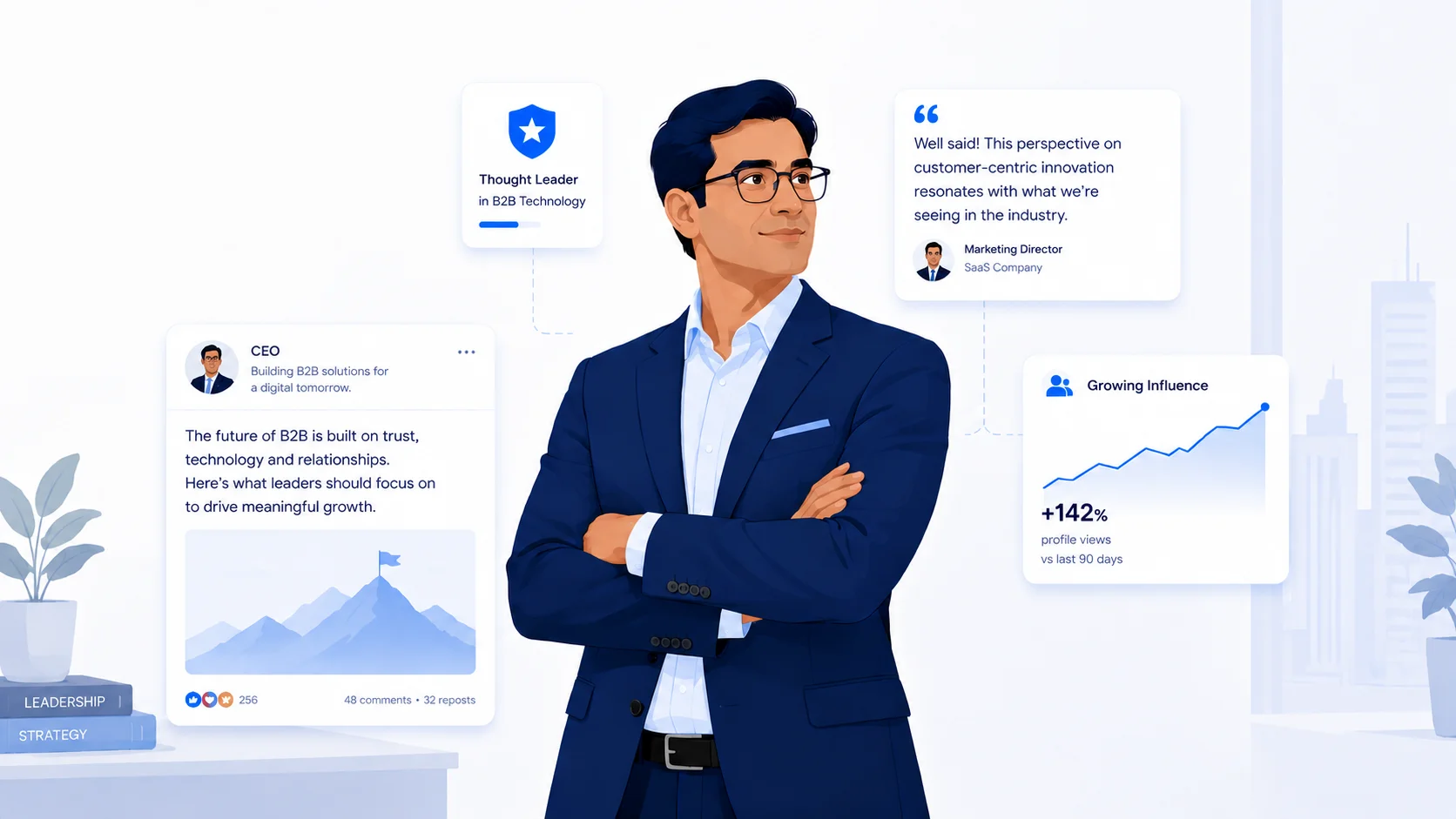
The CEO as B2B Influencer: A Positioning Playbook For Indian SMEs
LexiConn | Content Intelligence
Strategic positioning framework for Indian SME CEOs ready to commit to LinkedIn as a demand channel
Series: LinkedIn Personal Branding for Indian Founders | LexiConn 2026 Nithin Kamath posts about financial literacy for retail investors. Zerodha has not run a paid advertising campaign in over a decade. Girish Mathrubootham posts about India as a product nation. Freshworks attracted engineering talent at below-market salaries through reputation alone.
There is a pattern here. The CEO's reputation is doing commercial work that a marketing budget would struggle to replicate. The CEO as a B2B influencer in India is not a vanity project. It is a demand engine with a compounding return.
Searches for "CEO as influencer B2B strategy 2026" are up 110 percent this year. Most Indian SME CEOs have noticed. Very few have a systematic approach to making it work.
Why the CEO Is Uniquely Positioned to Be the B2B Influencer
A CEO as a B2B influencer in India is not a social media personality. It is an operator with earned authority who uses public content to move their category's conversation in a direction that is commercially useful to their company.
The structural reason this works is clear. Personal profiles generate 8x more engagement than company pages on LinkedIn. A post from a founder reaches further than the same post from a brand account because buyers assign different levels of trust to people versus logos.
That trust is not accidental. CEOs carry credibility signals that no marketing department can manufacture: skin in the game, a visible track record, and opinions that cost them something if proven wrong.
The 2025 Edelman-LinkedIn B2B Thought Leadership Impact Report found that 58 percent of B2B decision-makers read thought leadership content for at least an hour per week. Of those, 95 percent say strong thought leadership makes them more open to sales outreach from that organisation.
The CEO is also the only person in the organisation with legitimate authority to speak across the full surface of the business: product direction, market conditions, customer truths, and company values.
No VP of Marketing can credibly claim that territory. The CEO, as a B2B influencer in India, owns it structurally.
[ INTERNAL LINK: Brand vs. Demand is a false dichotomy: the founder's reputation IS the demand engine ]
The Positioning Question: What Specific Authority Do You Own
April Dunford's positioning framework, built for products, translates almost perfectly to personal brand. Positioning is not about describing what you do. It is about which specific context you occupy in your buyer's mind before they ever meet you.
The positioning question every CEO, as a B2B influencer in India, must answer before writing a single post: what is the one domain where your operating experience gives you a perspective that a consultant, journalist, or competitor cannot credibly replicate?
This is sharper than it sounds. Most Indian SME CEOs will initially answer with their industry. That is wrong. The industry is where you operate. The authority is what you see inside that industry that others do not.
A calibration test: can you name three specific claims about your domain that most peers in your industry would push back on, backed by your own experience? If yes, you have positioning material.
If you cannot name three, you are not yet ready to build a CEO as a B2B influencer strategy in India. You need more opinions before you need more content.
The 4 Positioning Archetypes (and an Indian Example for Each)
Four archetypes consistently produce the most commercially effective CEO as B2B influencers in India. Pick one. Running two simultaneously dilutes both.
| Archetype | What You Own | Content Signal | Indian CEO Example |
|---|---|---|---|
| Category Creator | A domain's definition and standards | Frameworks, category manifestos, criteria for good | Girish Mathrubootham, Freshworks |
| Democratiser | Access to complex or gate-kept knowledge | Explainers, data, accessible translations of complexity | Nithin Kamath, Zerodha |
| Contrarian | A specific, evidence-backed industry disagreement | Position-taking, challenge posts, frameworks with teeth | Kunal Shah, CRED |
| Operator-Storyteller | Transparency in real decision-making | Post-mortems, operational observations, honest trade-offs | Deepinder Goyal, Zomato |
Archetype 1: The Category Creator
This archetype stakes a claim on defining or leading a domain that did not previously have a widely accepted name or standard-setter.
Girish Mathrubootham did not just build Freshworks. He spent years writing and speaking about "India SaaS" as a category: what it means to build a global software product from India, for the world, at Indian cost structures. Freshworks became synonymous with that category.
Content pattern: writes about the category's evolution, sets criteria for what good looks like, and teaches others how to build inside it. The CEO, as a B2B influencer in India, in this archetype, becomes a reference point, not just a participant.
Archetype 2: The Democratiser
This archetype takes knowledge that was previously inaccessible or gatekept and makes it available to people who were excluded from it.
Nithin Kamath built Zerodha's entire brand on financial literacy. His LinkedIn posts do not sell Zerodha. They explain how derivatives work, why retail investors lose, and what market microstructure looks like from inside a brokerage. The product sells itself once the category is understood.
Content pattern: translates industry complexity into frameworks, analogies, and accessible data that buyers can act on without needing a specialist.
Archetype 3: The Contrarian
This archetype challenges the dominant narrative in their sector with evidence and first-person proof, not just contrarian opinions.
Kunal Shah of CRED built a following of Indian business leaders not by posting about CRED but by developing frameworks like the Delta-4 theory and publishing sharp, uncomfortable observations on India-specific consumer behaviour.
Most fintech founders hold similar views privately. Shah is one of the few who state them publicly with reasoning. That willingness to be specific and defensible is the archetype's engine.
Content pattern: takes clear positions on contested industry questions, backs them with reasoning or experience, and does not retreat when challenged.
Archetype 4: The Operator-Storyteller
This archetype builds authority through transparent accounts of how the company actually makes decisions: not press-release decisions, but real trade-offs with real costs.
Deepinder Goyal's most-engaged LinkedIn posts are not about Zomato's growth metrics. They are posts where he shares hiring decisions, operational challenges, and genuine uncertainty about choices in progress.
A 2023 Chief of Staff post attracted over 2,000 comments because it felt genuinely unscripted. That authenticity cannot be manufactured. It is the archetype's defining credential.
Content pattern: shares decision-making rationale, honest post-mortems, and operational observations that buyers recognise from their own businesses.
How to Test Your Positioning in Two Weeks
Before committing to a 12-month strategy, run a two-week test. It costs nothing except the discomfort of having a public opinion.
Step 1: Pick one archetype and one specific domain within your industry. Not "manufacturing" or "B2B SaaS." Something more specific: capital allocation in family-owned mid-market businesses, or GTM strategy for Indian SaaS targeting Southeast Asia.
Step 2: Publish three posts over 14 days, all anchored to that domain, each with a distinct and clear POV. No motivational reframes. No trend summaries. Your earned opinion, with a stated reason.
Step 3: Measure the signal. Who comments? Are they prospects or peers? Are connections from people who match your ICP or from fellow founders seeking validation?
The signal that validates the CEO as a B2B influencer positioning in India: a target buyer commenting, "We are dealing with exactly this problem," is worth more than 500 likes from peers. Peer validation feels good. Buyer validation builds a pipeline.
If, after two weeks, you are getting peer engagement primarily, the domain is right, but the angle is too internal. Shift the framing toward your buyer's problem, not your industry's internal conversations.
Common Positioning Failures: The Traps Indian CEOs Fall Into
The Generalist Trap
You post about AI trends on Monday, leadership lessons on Wednesday, market observations on Friday, and a wellness insight on Saturday. You think you are being versatile. Your buyer sees noise.
Nobody in a B2B buying process looks for the CEO who posts about everything. They look for the CEO who clearly understands their specific problem. Posting about everything means owning nothing.
The CEO, as a B2B influencer in India who tries to appeal to everyone, becomes recognisable to no one. Specificity is not a limitation. It is the mechanism by which positioning works.
The Borrowed Authority Trap
You spend your posts summarising McKinsey research, sharing Gartner predictions, and explaining frameworks from business books. The content appears credible. The problem is that none of it is yours.
Borrowed authority makes you a well-read curator, not an operator with hard-won views. Your buyer already has access to McKinsey. What they want from the CEO as a B2B influencer in India is what McKinsey does not know.
59 percent of B2B buyers consume creator content on LinkedIn specifically. They are not looking for summaries of reports that they can access themselves. They are looking for operators who have been inside the problem.
[ INTERNAL LINK: The AI slop epidemic on LinkedIn: how to write like a human again ]
Building the Editorial Line: What You Publish vs What You Avoid
An editorial line is not a content calendar. It is a set of rules about what you will and will not publish, anchored to your chosen archetype and domain.
| Publish | Avoid |
|---|---|
| Opinions earned from your own deals and decisions | Motivational content, unless inspiration is your archetype |
| Market observations specific to your vertical | Opinions on topics outside your positioning domain |
| Honest accounts of decisions that failed, and what you learned | AI-generated or AI-summarised trend reports |
| Contrarian takes backed by operating experience | Posts designed for peer validation rather than buyer relevance |
| Data or frameworks from your own business operations | Reposts of others' content without your own layer of proof |
The editorial line has one test: does this post advance your positioning, or does it simply fill the calendar? If the latter, do not publish it.
Most Indian SME CEOs underpost on the topics that would build the most pipeline and overpost on the topics that feel safest. Public opinions are uncomfortable to hold. That discomfort is exactly what makes them worth reading.
[ INTERNAL LINK: Why your motivational LinkedIn posts are dying in 2026 (and what to write instead) ]
Maintaining Positioning Over 12 Months
Most CEO as B2B influencer in India fail not because the positioning was wrong, but because it was abandoned too early. The typical pattern is predictable.
A CEO launches a focused effort in January, gets early traction, notices high engagement from peers, starts widening topics to maintain momentum, and by June is posting about everything again.
Maintaining positioning over 12 months requires a structural commitment, not a motivational one.
Three mechanics that work consistently for Indian SME CEOs:
-
One anchor post per week minimum on your domain, regardless of what the previous week's engagement looked like. Consistency is not a growth tactic. It is the positioning itself.
-
Quarterly positioning review: Are the people commenting and connecting matching your ICP? If most of your engagement is from peers and not prospects, something in the content angle needs to shift.
-
When an off-topic post gets high engagement, treat it as data about what your followers find interesting. Do not treat it as a reason to pivot your positioning. The CEO as a B2B influencer in India is not optimising for engagement. They are building a reputation with a specific buyer.
Positioning drift is the most common failure mode in year one. You are not positioning for your current followers. You are positioning for the buyer who will discover you six months from now and read your back catalogue.
That buyer will not find a generalist. Give them something specific to remember you by.
[ INTERNAL LINK: Voice-match architecture: scaling founder content without killing authenticity ]
Start here: tomorrow morning, write down the one domain where you have an opinion that most people in your industry would push back on. That is your positioning starting point. Not a content calendar. Not a profile refresh. An opinion you are willing to defend.
Key Takeaways
-
A CEO as a B2B influencer in India is an operator with earned authority using content to move their category's conversation commercially, not a social media personality optimising for follower counts.
-
Personal profiles generate 8x more engagement than company pages. The CEO's voice carries trust signals no marketing department can manufacture, and 95 percent of B2B buyers say strong thought leadership makes them more receptive to sales outreach.
-
The four archetypes, Category Creator, Democratiser, Contrarian, and Operator-Storyteller, represent the only reliable positioning modes that build a B2B pipeline. Attempting two simultaneously dilutes both. Pick one and commit for at least 12 months.
-
The Generalist Trap (posting about everything \= owning nothing) and the Borrowed Authority Trap (summarising others' research instead of sharing earned opinions) are the two failure modes that derail efforts by most Indian CEO as B2B influencers in India.
-
Positioning is not for your current audience. It is for the buyer who discovers you in six months and reads your back catalogue. Consistency is not a growth tactic, it is the positioning itself.
FAQs
1. What does it mean for a CEO to be a B2B influencer in India?
A CEO as a B2B influencer in India uses public content to build specific authority in their domain, making them a reference point for buyers before any sales conversation begins. It is a positioning strategy, not a social media one.
2. How is a CEO's positioning on LinkedIn different from personal branding?
Personal branding is about how you are perceived broadly. CEO positioning on LinkedIn is commercially specific: it targets a defined buyer profile, addresses their domain problems, and builds authority that directly shortens the sales cycle.
3. What if a CEO does not have a strong public opinion in their industry?
That is a positioning problem, not a content problem. Spend two weeks writing down disagreements you hold internally about your industry. If you cannot identify any, your operating experience may need deeper reflection before a LinkedIn strategy makes sense.
4. Can a CEO delegate LinkedIn content to a ghostwriter?
The content strategy and editorial line can be structured with support. But the core opinions, the specific examples from deals and decisions, and the authentic responses to comments must come from the CEO. Ghostwritten positioning collapses the moment a prospect asks a follow-up question.
5. How long before a CEO's LinkedIn positioning shows commercial results?
Most Indian SME CEOs running a focused CEO as a B2B influencer strategy in India see inbound signals, warm introductions, or shortened sales cycles within 90 to 120 days. Pipeline attribution typically becomes measurable by month six.
Sources
1. 2025 Edelman-LinkedIn B2B Thought Leadership Impact Report
2. LinkedIn Statistics 2026 (personal profile vs company page reach)
3. April Dunford: Positioning for B2B Tech Companies
4. Storyboard18: Nithin Kamath as Zerodha's social media manager
5. SeedToScale: Girish Mathrubootham profile
6. Fame Keeda: B2B Influencer Marketing India 2026
7. Sproutwoth: Thought Leadership Strategy, CEO Guide
8. Prophet: Building a Strong CEO Brand (2025)
9. Favikon: Top LinkedIn Influencers India 2026
10. Column Content: 2026 Thought Leadership Statistics and Trends
Word Count: 2,506
Generated for LexiConn Content | lexiconn.in | May 2026
Need expert content support? LexiConn has been India's B2B content partner since 2009, building content systems for leading enterprise brands across BFSI, technology, and media. Explore our thought leadership services →