
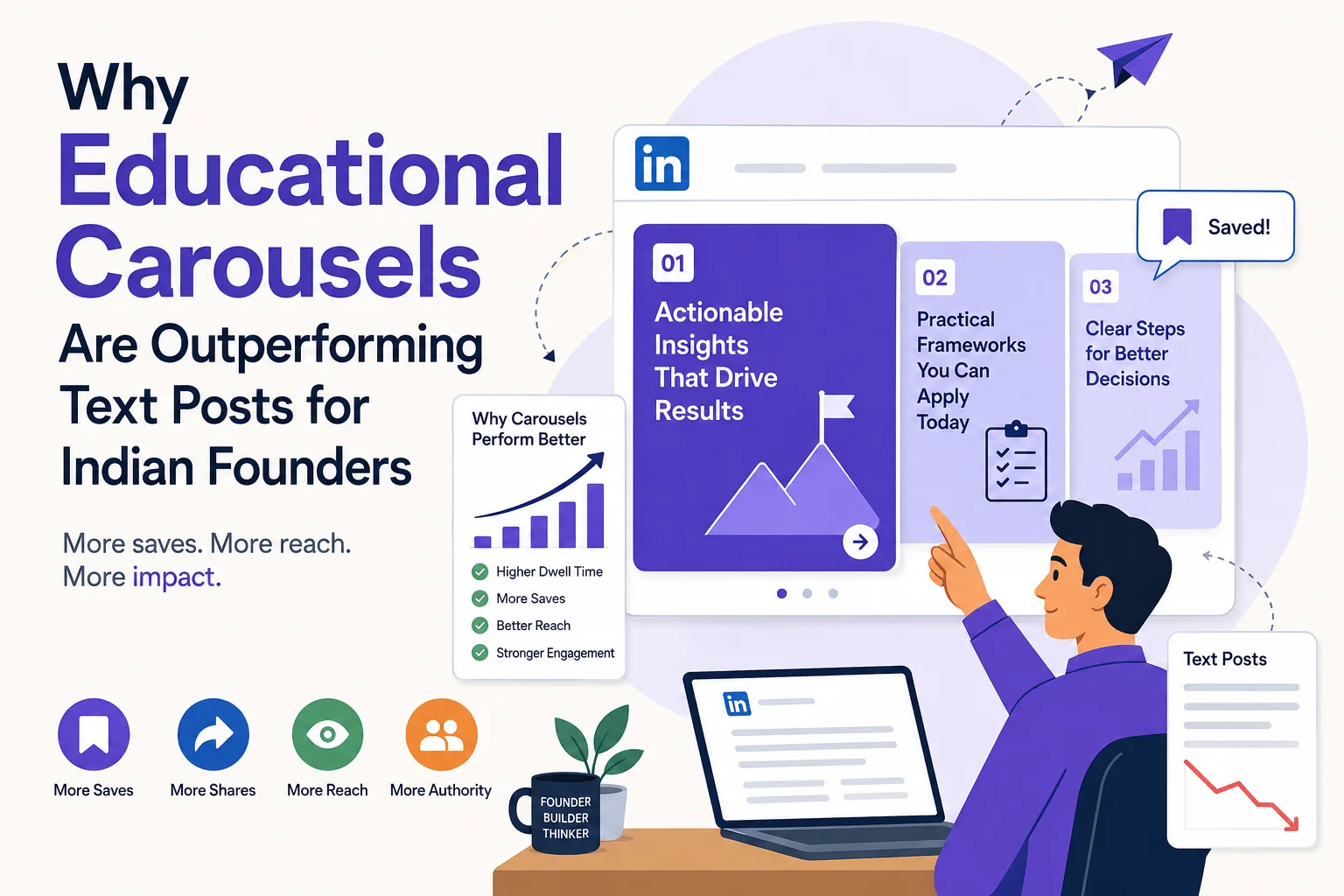
Why Educational Carousels are Outperforming Text Posts for Indian Founders
There's a quiet shift happening on LinkedIn feeds across India.
A founder posts a thoughtful wall of text, 250 words, sharp insight, real experience. It gets 40 likes and fades in 18 hours. The next day, they post a 10-slide educational carousel covering the same idea. It gets 600 likes, 85 reposts, and 40 new connection requests from people they've never met.
Same founder. Same idea. Very different result.
This isn't a fluke, it's a pattern repeating itself across hundreds of Indian founders who've cracked the LinkedIn carousel strategy. And it's changing how B2B thought leadership is built in this country.
If you're still betting on text posts as your primary content format, this is worth reading carefully.
The Shift in LinkedIn Content Consumption
LinkedIn has changed more in the last three years than in the decade before that. The platform has gone from a digital resume board to an active content ecosystem, one where users spend real time engaging with ideas, not just updating job titles.
But user behavior hasn't just grown. It's changed shape.
Text Posts Are Losing the Battle for Attention
In 2021, a well-written text post from a credible founder could reliably drive engagement. Audiences were less saturated. Feeds were less competitive. Even a decent thought, plainly written, could cut through.
That's no longer true.
LinkedIn's feed is more crowded than ever. Users are scrolling faster. Attention is fragmenting. And the algorithm, which LinkedIn has never fully disclosed but which content researchers have mapped closely, is increasingly rewarding content that keeps people on the post longer.
Text posts typically get skimmed in four to seven seconds. If nothing hooks immediately, they're gone, buried under the next piece of content. This is the core problem with the format: it has no mechanism to hold attention beyond the first line.
The Rise of Visual, Structured Content
Carousels are structured, visual, and interactive. They don't just communicate information, they ask users to do something. Swipe. Move forward. Stay engaged.
That behavioral difference is massive.
Every swipe sends a signal to LinkedIn's algorithm: this content is worth spending time on. Multiply that across dozens or hundreds of viewers, and the carousel accumulates "dwell time" signals that text posts simply can't match.
The data support this. Content researchers tracking LinkedIn post performance consistently find that carousels generate 3x to 10x more impressions than equivalent text posts, depending on the niche and audience. For founders specifically, who are building authority-based personal brands, the gap is even wider.
Why Educational Carousels Work Better
The answer isn't just "they look nice." The mechanics behind carousel performance run deep.
Dwell Time Advantage
LinkedIn's algorithm tracks how long users spend with each piece of content. This is its proxy for content quality. A post that gets scrolled past in three seconds signals low value. A post where users spend 40 seconds swiping through slides signals high value.
Educational carousels, by design, extend engagement time. A 10-slide carousel with substantive content can hold a reader for 45 to 90 seconds. That's an eternity compared to a text post. And every second of that dwell time compounds into algorithmic distribution.
Information Chunking
Humans process information better in small, structured chunks. This isn't a design preference, it's cognitive science. The brain handles sequenced, bite-sized information with lower cognitive load than long-form prose.
Educational carousels are perfectly suited to this. Each slide covers one idea. The visual separation creates natural pauses. The progression feels logical, not overwhelming. Readers absorb more, and remember more, from a well-structured carousel than from an equally substantive wall of text.
This is why teaching hospitals use visual aids. Why consultants use slide decks. Why the format works for communicating complex ideas clearly.
Saveability and Shareability
Here's a metric most founders overlook: saves.
When someone saves a LinkedIn post, they're signaling extreme value, "I want to come back to this." Saves drive algorithmic distribution significantly more than likes, because they indicate genuine usefulness rather than passive approval.
Educational carousels earn saves at a much higher rate than text posts, for an obvious reason: they're reference material. A carousel titled "7 Questions to Ask Before Hiring Your First Sales Leader" or "How to Structure a Founder Update" is something a reader might genuinely want to revisit.
Text posts, by contrast, are consumed once and forgotten. They don't have the "keep this" quality that drives saves.
Shareability works similarly. Carousels get reshared more because they make the person sharing them look thoughtful, look at this useful thing I found. Text posts, however good, rarely travel that way.
Algorithm Amplification
LinkedIn's algorithm doesn't just reward engagement. It rewards types of engagement in different ways.
Comments carry significant weight. Reposts carry weight. But the combination of dwell time + saves + reposts is particularly powerful, and carousels generate all three at above-average rates.
The practical effect: a carousel that performs well in the first two to four hours gets amplified to a much wider audience than a text post with similar initial engagement. The flywheel starts spinning earlier and faster.
Authority Signaling
There's a subtler reason carousels outperform text posts for founders specifically: they signal effort and expertise.
A carousel requires structure. It requires visual thinking. It requires the ability to distill a complex idea into sequential, digestible slides. When a founder produces a genuinely good educational carousel, it signals more than the information itself, it signals that they understand the topic deeply enough to teach it clearly.
This is authority signaling. And in a B2B ecosystem where buyers are evaluating founders as much as they're evaluating products, that matters enormously.
Why This Is Especially True for Indian Founders
The global LinkedIn playbook is relevant, but the Indian founder context adds specific dimensions that make carousels even more powerful here.
High Content Saturation
The Indian startup ecosystem has exploded over the last five years. Thousands of founders are now active on LinkedIn, many posting regularly, many posting well. The result is a saturated feed where standing out requires more than a good idea. It requires a format that forces the algorithm to give you reach.
Carousels do this more reliably than any other format.
The Need for Differentiation
In a crowded space, format itself becomes a differentiator. When most founders are posting text, a founder who consistently publishes well-designed educational carousels occupies a distinct visual space in the feed. They become recognizable before anyone reads a word.
That visual identity compounds over time. Readers begin to associate a specific look, a particular style, color scheme, tone, with a specific founder. That's brand building, and carousels enable it more naturally than text.
Trust-Building in B2B Ecosystems
Indian B2B buyers, on average, take longer to reach purchase decisions than their Western counterparts. Relationships and demonstrated expertise carry more weight in the sales cycle. Trust is earned slowly, through repeated exposure to credible, useful content.
Educational carousels are exceptionally well-suited to this. They demonstrate expertise visually and clearly. They give buyers something to evaluate before a conversation happens. And they build the familiarity that accelerates trust, especially when a founder posts consistently over months.
A Learning-Oriented Audience
Indian professionals on LinkedIn are disproportionately oriented toward learning. The platform's fastest-growing content categories in India lean heavily toward educational material, how-to guides, strategic frameworks, industry insights.
This is an audience primed for educational carousels. They're already seeking structured learning. A founder who delivers it consistently earns not just engagement, but loyalty.
Carousel vs. Text Posts: A Practical Comparison
Understanding why carousels outperform text posts is one thing. Knowing when to use each is another.
| Educational Carousels | Text Posts | |
|---|---|---|
| Best for | Teaching, frameworks, insights, how-tos | Opinions, reactions, stories, commentary |
| Dwell time | High (swipe-driven) | Low (skim-driven) |
| Save rate | High (reference value) | Low |
| Shareability | High | Moderate |
| Effort | High (design + structure required) | Low |
| Algorithmic reach | High, especially for second-wave distribution | Lower ceiling |
| Authority signal | Strong | Moderate |
Text posts aren't obsolete. They work well for real-time commentary, quick takes, vulnerability-led stories, and conversational posts that invite replies. They're lower effort and can build warmth and relatability.
But for founders trying to build authority, to become the go-to voice on a specific topic, carousels are the format of choice. They're where expertise lives.
A well-rounded content strategy uses both: carousels for depth and authority, text posts for personality and connection.
What Makes a High-Performing Educational Carousel
Not all carousels perform equally. The format is powerful, but execution determines whether a carousel spreads or sinks.
Hook Slide Strategy
The first slide is everything. If it doesn't stop the scroll, nothing else matters.
Effective hook slides have one of three characteristics: they make a bold claim ("Most founders get pricing wrong, here's what the data shows"), pose a sharp question ("Why do 80% of B2B demos fail?"), or promise a clear outcome ("10 things every first-time founder wishes they knew before Series A").
Vague hooks kill reach. Specificity and tension are the tools.
Narrative Flow
A carousel is a story told in slides. Each slide should build on the previous one, creating forward momentum that makes swiping feel natural, even necessary.
Structure matters here. A common high-performing flow: hook -> problem -> insight -> proof -> framework -> conclusion -> CTA. Readers who can feel the logic unfolding stay engaged longer.
Visual Clarity
Design doesn't need to be elaborate. But it needs to be clean, consistent, and scannable.
Text-heavy slides with poor hierarchy confuse readers. Slides with a single, bold headline and two to three supporting lines perform better. Consistent fonts, consistent colors, consistent margins, these create a professional visual identity that makes content feel trustworthy before it's even read.
Insight Density
The best educational carousels deliver one substantive insight per slide. Not ten bullet points. One idea, stated clearly.
Insight density is the difference between a carousel that gets saved and one that gets swiped through once and forgotten. If every slide teaches something genuinely useful, the cumulative effect is a post that readers want to revisit.
CTA Design
The final slide is often underthought. After 10 slides of value, the CTA should feel like a natural extension, not a jarring pivot to promotion.
Effective CTAs for founder carousels: "What's your take? Drop it in the comments." or "Follow for more frameworks like this." or "DM me if you want to explore this further." The goal is to convert engagement into conversation.
Common Mistakes Founders Make
Even founders who've committed to carousels often fall into predictable traps.
Over-designing. Spending hours on aesthetics without equal investment in ideas. Beautiful slides with thin content don't perform. Design serves insight, not the other way around.
Under-thinking content. Rushing from idea to slide without building the argument first. The best carousel creators outline their narrative in plain text before designing a single slide.
No clear structure. Slides that feel like a random collection of related thoughts rather than a cohesive sequence. Every carousel needs a beginning, middle, and end.
No clear takeaway. Readers should finish a carousel knowing exactly what they've learned and what they can do with it. Vague, philosophical carousels leave readers engaged but unanchored. Actionable, specific carousels get saved.
Inconsistent posting. Publishing three carousels in a week, then disappearing for a month. LinkedIn's algorithm rewards consistent creators. Irregular posting means starting from zero each time.
How to Build a Consistent LinkedIn Content Engine
The founders who win on LinkedIn over the long term aren't the ones who write the best individual posts. They're the ones who've built systems that make consistent output possible.
Thought Capture vs. Content Creation
Most founders have no shortage of ideas. They're navigating real problems, making difficult decisions, and learning constantly. The challenge isn't generating content, it's capturing insight before it evaporates.
Build a simple capture habit: a running note, a voice memo, a quick Notion entry whenever something interesting happens. Hiring a key person, losing a deal, discovering a market insight, and navigating a conflict. These are the raw materials for your best carousels.
Content creation becomes dramatically easier when you're pulling from a well of captured experience, not trying to invent ideas from scratch.
Systems Over One-Off Posts
The founders who post consistently have reduced the friction of content creation. A simple, repeatable process: capture an idea -> outline the argument -> structure into slides -> design -> publish.
Each step is manageable in isolation. The mistake is treating every post as a bespoke creative project, which guarantees inconsistency.
Content Repurposing
A strong educational carousel is a content asset, not a throwaway post. It can be repurposed into a LinkedIn newsletter section, a thread, a blog post, a section of a pitch deck. The work done once pays dividends across multiple channels.
Building Personal Brand Authority at Scale
This is where many founders hit a ceiling. They understand the strategy, have the ideas, but don't have the bandwidth to execute consistently. Thought capture is one thing. Turning it into polished, insight-dense carousels week after week is another.
This is the gap that LexiConn helps founders close.
Rather than replacing the founder's thinking, LexiConn works as a partner in extracting and structuring it, turning raw ideas and expertise into content that actually lands. The goal isn't to outsource your voice. It's to build systems that make your voice consistent and visible.
For founders who want to show up on LinkedIn not just occasionally, but as a genuine authority in their space, professional support for LinkedIn personal branding makes the difference between inconsistent bursts and a real content engine.
The best founders aren't writing every carousel themselves. They're spending time thinking, and working with partners who know how to translate that thinking into content that performs.
Conclusion: Rethink Your LinkedIn Content Strategy
The era of posting a paragraph and waiting for the algorithm to be kind is effectively over, at least for founders trying to build real authority.
Educational carousels have become the dominant format for a reason. They align with how the LinkedIn algorithm distributes content. They match how modern professionals consume information. They build the kind of trust and authority that a B2B audience requires before they engage, refer, or buy.
For Indian founders operating in a saturated, relationship-driven ecosystem, the case is even stronger. The founders who are winning attention, and using that attention to build business, have made carousels a cornerstone of their content strategy.
The shift has already happened. The question is whether you're leading it or watching it.
Ready to build a LinkedIn content strategy that actually works?
Explore LexiConn's LinkedIn personal branding services designed specifically for founders and senior leaders, or reach out to discuss a pilot engagement tailored to your goals.
Need expert content support? LexiConn has been India's B2B content partner since 2009, building content systems for leading enterprise brands across BFSI, technology, and media. Explore our thought leadership services →