
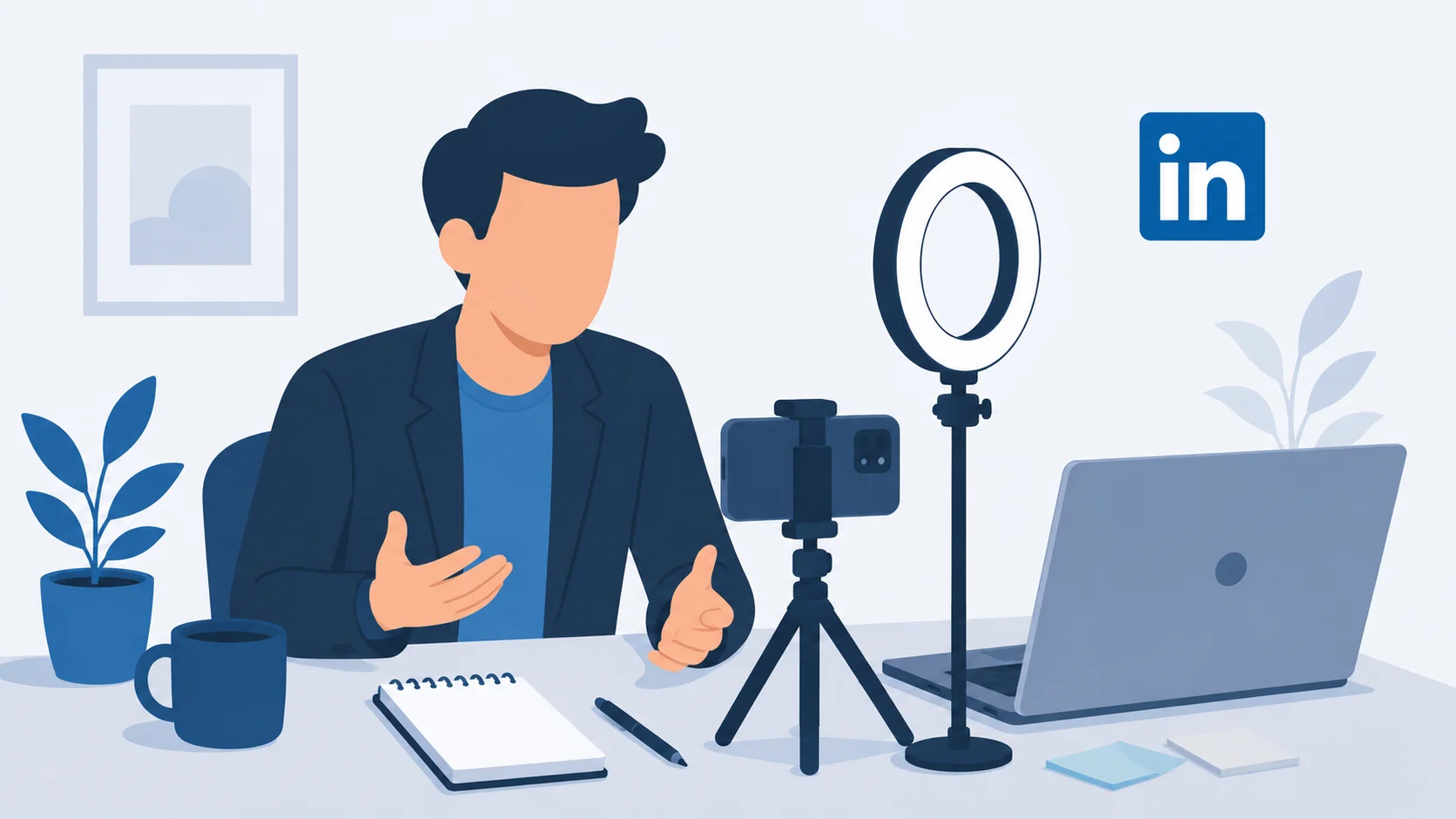
Short-Form Executive Video: A Playbook for Camera-Shy SME Founders
LinkedIn founder videos are no longer optional. Video views on the platform crossed 154 billion in 2024, growing 36% year over year. B2B buyers now expect quick, human-led answers, and 79% rely on video to decide on B2B products. In other words, short-form video is no longer optional for founders who want to build authority and stay visible.
The good news is that you do not need a studio, expensive production, or polished editing to make this work. Most high-performing founder videos today are simple, direct, and recorded with minimal setup. A clear idea, a smartphone, and 10 to 15 minutes are enough to create content that builds trust with potential buyers. Below is a zero-fluff playbook for making four easy founder video formats in under 15 minutes each, using minimal gear.
Why Short-Form Video Matters in 2026
B2B video is exploding. Buyers now prefer quick, human-led content over polished corporate marketing. They want to hear directly from founders, not brand ads.
The numbers make the shift clear:
- 59% of B2B marketers now use video.
- 90% say video helps generate leads.
- LinkedIn video views crossed 154 billion in 2024 and are still growing.
- Video posts get 20× more shares than text or image posts.
Founder videos work especially well because people trust people more than company pages. According to LinkedIn’s B2B Institute, 82% of B2B buyers value leadership expertise when making decisions. Founder-led content can drive up to 315% more engagement than brand content.
Authenticity matters too. LinkedIn data shows emotional, natural-looking videos get 78% more engagement than staged corporate footage. Simple videos recorded on a phone often outperform highly produced content.
LinkedIn has now become the top platform for B2B video sharing. Wistia’s 2026 report found that 80% of B2B teams use LinkedIn as their primary video channel, ahead of YouTube. In India alone, LinkedIn crossed 160 million users in 2025, creating a massive audience for founder content.
The platform is also pushing short-form video harder. Early creator tests show vertical videos between 30 and 60 seconds can increase reach by nearly 23%.
The best part is that you do not need expensive equipment to start. A smartphone, decent lighting, and a clear idea are enough. As Ankur Warikoo says, “If you keep waiting for the right tool, you will never give your talent a chance.”
The 4 Video Formats That Actually Work for B2B Founders
There are dozens of ways to make LinkedIn videos, but most are unrealistic for busy founders with no production team. The best founder videos are simple, fast to record, and easy to repeat consistently.
The four formats below work because they do three things well:
- They can be recorded in a single take with minimal scripting.
- Each format serves a clear business goal.
- They stay effective over time instead of feeling repetitive after a few posts.
| Format | Duration | Prep Time | Best For | Difficulty |
|---|---|---|---|---|
| Single-Insight Teardown | 60, 90 sec | 10 min | Educating cold audiences | Low |
| Customer Story | 90, 120 sec | 15 min | Building trust with warm leads | Low, Medium |
| Contrarian Take | 45, 60 sec | 8 min | Reach and new followers | Medium |
| Framework Walkthrough | 90, 180 sec | 15 min | Deep credibility and referrals | Medium |
Format 1: Single-Insight Teardown (60, 90 Seconds)
What It Is
This is one of the easiest founder video formats to record. You take a single insight, statistic, chart, lesson, or industry myth and explain it in under 90 seconds.
The goal is not to teach everything. The goal is to make one useful point people remember.
For example:
- A manufacturing founder explains how process changes reduced factory waste by 15%.
- A SaaS founder shares the one onboarding mistake causing most customer churn.
- A consultant breaks down a common industry myth that is quietly hurting profits.
Start with the insight immediately, give quick context, and end with a simple takeaway.
Why It Works
B2B audiences respond well to fast, practical education. A short video focused on one idea feels easier to consume and easier to remember.
Instead of overwhelming viewers with too much information, this format creates clarity. One strong data point combined with a founder’s personal experience instantly makes the content feel more credible and useful.
The best teardown videos make people think:
“I did not know that.”
How to Record It
Keep the structure simple:
- Start with a strong opening line
- Share the insight or statistics.
- Explain why it matters in plain language
- End with one clear takeaway
Example opening:
“Here’s one thing most CEOs get wrong about customer churn.”
You can hold up a slide, point to a chart, or simply explain the insight directly to the camera. The simpler the setup, the more natural the video feels.
Why Founders Should Use It
This format builds authority quickly because you are teaching from direct experience. You are not repeating generic advice. You are showing real observations, real numbers, and real lessons from the business.
A strong insight plus a simple explanation is often enough to earn saves, shares, and inbound conversations on LinkedIn.
Format 2: Customer Story (90, 120 Seconds)
What It Is
This format is a short customer success story told like a mini case study. Instead of talking about your company directly, you talk about a real problem a customer faced, what you helped them change, and the result they achieved.
It works best when the story feels simple, specific, and relatable.
For example:
- A clinic struggling with missed bookings.
- A factory is facing hiring delays.
- A SaaS customer is dealing with high churn.
- A retailer is losing sales because of manual processes.
The structure is simple: problem, solution, result.
Why It Works
People remember stories far more than generic advice. Even in B2B, buyers connect emotionally with real business problems and real outcomes.
A customer story makes your expertise feel practical instead of promotional. It also acts as social proof because viewers can immediately picture how your solution works in a real situation.
Authentic, human-led stories also tend to perform well on LinkedIn because they feel natural, useful, and experience-driven.
How to Record It
Keep the storytelling structure tight:
- Introduce the customer or business type.
- Explain the challenge.
- Share what you changed.
- End with the measurable result.
Speak conversationally, like you are explaining the story to another founder.
Example opening:
“One of our clients was losing nearly 30% of inbound leads because their booking process was too slow.”
Avoid corporate language. Use simple explanations and real outcomes.
Why Founders Should Use It
Customer stories build trust because they show proof instead of promises. They help potential buyers see the practical impact of your work without sounding overly sales-driven.
The key is to keep the story focused, conversational, and outcome-driven. One clear problem and one clear result are enough to make the video memorable.
Format 3: Contrarian Take (45, 60 Seconds)
What It Is
This format is simple: take a popular industry opinion and challenge it.
You start with a statement most people already believe, then explain why you disagree based on your own experience.
These videos are short, opinion-driven, and designed to spark conversation.
For example:
- “Everyone says bigger teams scale faster. I think smaller teams make better decisions.”
- “Most founders obsess over growth. I think retention matters more.”
- “People think AI will replace experts. I think it will make expertise even more valuable.”
The goal is not to be controversial for attention. The goal is to present a thoughtful perspective that people do not hear often.
Why It Works
LinkedIn rewards strong expert opinions because they naturally create discussion. A clear point of view makes people stop scrolling, even if they do not fully agree.
Contrarian takes also help founders stand out in crowded industries where most content sounds identical. Instead of repeating common advice, you are showing how you think differently.
When the insight is grounded in real experience, these videos often drive comments, reposts, and profile visits.
How to Record It
Keep the structure sharp and direct:
- Start with the common belief.
- Immediately challenge it.
- Explain your reasoning.
- End with one memorable takeaway.
Example opening:
“Everyone says hiring experienced people is always safer. I think that is exactly what slows many startups down.”
You do not need slides, editing, or visuals for this format. Your conviction and clarity are what make the video work.
Why Founders Should Use It
Contrarian videos position founders as thinkers, not just operators. They help audiences understand how you approach problems differently from the rest of the market.
The key is to stay thoughtful, specific, and experience-driven. Strong opinions work best when they feel informed, not performative.
Format 4: Framework Walkthrough (90, 180 Seconds)
What It Is
This format is about teaching a simple framework, process, or checklist from your experience.
Instead of sharing one insight or story, you break down a problem into clear steps people can follow. These videos work especially well for founders who want to build deep credibility in their niche.
Examples include:
- “My 3-step process for improving B2B sales calls.”
- “The 4 things we check before hiring senior talent.”
- “How do we evaluate marketing channels before spending money?”
The goal is to simplify something complex into a practical framework that people can remember and apply.
Why It Works
LinkedIn audiences love structured, educational content because it feels practical and actionable. Framework videos are highly “savable” since viewers often want to revisit them later.
They also position founders as operators with real systems and experience, not just opinions. Instead of saying you understand a topic, you are actively teaching how you approach it.
This format usually drives strong saves, shares, and referrals because people often send frameworks to teammates or colleagues.
How to Record It
Start by clearly defining the topic in one sentence.
Example:
“Great B2B sales is not about pitching features. It is about diagnosing business problems.”
Then walk through the framework step by step.
A simple structure works best:
- Step 1: Name the step and explain it briefly.
- Step 2: Share the next action or principle.
- Step 3: End with the final outcome or recommendation.
Pause slightly between points so the structure feels easy to follow. You can also add simple on-screen text for each step if needed.
Why Founders Should Use It
Framework videos build long-term authority because they teach audiences how you think and operate. Over time, people begin associating you with clarity, expertise, and practical problem-solving.
The key is to keep the framework simple. Three strong steps explained clearly will always perform better than a complicated 10-point lecture.
Production-Light Setup: Phone, Light, Audio, and a 15-Minute Workflow
The biggest mistake founders make is assuming they need a professional studio before they start recording videos. They do not.
Many of the founder videos performing well on LinkedIn in 2026 were recorded on smartphones inside offices, meeting rooms, home workspaces, or near windows with basic lighting. The production standard is lower than most people think. What matters more is clarity, confidence, and authenticity.
| Component | What Works | What to Avoid |
|---|---|---|
| Phone | Use a modern smartphone with the rear camera placed at eye level | Avoid shaky handheld videos or low-quality front camera recording |
| Lighting | Record near natural window light or use a simple ring light | Avoid dark rooms, harsh overhead lighting, or strong backlighting |
| Audio | Wired earphones with an inbuilt mic work surprisingly well | Avoid recording from too far away using the phone mic |
| Background | A clean wall, bookshelf, workspace, or office setup works best | Avoid cluttered rooms or distracting virtual backgrounds |
| Captions | Use auto-generated captions through editing apps or LinkedIn | Avoid uploading videos without captions since most people watch on mute |
15-Minute Recording Workflow
You do not need hours of planning or editing to create a strong founder video. A simple 15-minute workflow is enough for most LinkedIn content.
Step 1: Prep, 5 Minutes
Spend a few minutes outlining your key talking points.
- Write quick bullet points instead of a full script.
- Focus on one idea only.
- If you are using a chart or slide, keep one simple visual ready.
- Decide your opening line before recording.
Example:
“Here’s one mistake most founders make while hiring.”
Step 2: Record, 5 to 7 Minutes
Place your phone at eye level using a tripod, table stand, or stack of books.
- Record in natural light if possible.
- Speak like you are talking to one person.
- Keep your energy slightly higher than normal conversation.
- Do one or two takes and move on.
Do not aim for perfection. Natural delivery performs better than overly scripted videos.
Step 3: Quick Edit, 5 Minutes
Use your phone’s editor or a simple free editing app.
- Trim awkward starts and endings.
- Add auto-captions.
- Add a short headline if needed.
- Keep edits minimal and clean.
Most LinkedIn founder videos do not need heavy editing.
| Gear / Tool | Cost Range | Setup Time | Notes |
|---|---|---|---|
| Smartphone with rear camera | Already owned | Instant | Most modern phones are enough for LinkedIn videos |
| Natural light or simple ring light | ₹0, 2,000 | 1, 2 minutes | Window light works surprisingly well |
| Wired clip-on microphone | ₹500, 1,500 | 1 minute | Helpful for clearer voice recording |
| Tripod or phone stand | ₹0, 2,000 | 1 minute | Even books or a desk setup can work |
The biggest advantage of LinkedIn in 2026 is consistency, not production quality. Founders who publish regularly and speak authentically usually outperform founders waiting for “perfect” videos.
What To Do Tomorrow Morning
Pick one format and shoot a video within 15 minutes of working time:
- If you have a quick insight (data, tip), do a Single-Insight Teardown.
- If you have a client story or example, shoot a Customer Story.
- If a bold opinion is on your mind, film a Contrarian Take.
- If you have a mini-framework or process, try a Framework Walkthrough.
Choose any topic you know well. Write just a few bullet points, set up your phone by a window or lamp, and hit record. Don’t wait for perfect lighting or editing, start sharing your real voice now.
Building momentum is a compound process, not a one-off stunt. Your next post will amplify this one. Ready? Turn your phone around and show up; your LinkedIn audience is waiting.
Key Takeaways
- LinkedIn founder video is now a core B2B visibility channel
- Buyers trust human-led founder content more than polished brand marketing
- Short-form videos drive stronger reach, shares, and engagement than static posts
- Four simple formats are enough to build consistent founder visibility
FAQs
1. Do founders need professional video equipment to create LinkedIn videos?
No. Most high-performing founder videos on LinkedIn are recorded using smartphones, natural lighting, and basic audio setups. Clear ideas and natural delivery matter far more than expensive production.
2. Which founder video format works best for beginners?
The Single-Insight Teardown is usually the easiest starting point. It requires minimal preparation, works well in under 90 seconds, and helps founders build confidence on camera quickly.
3. How often should founders post videos on LinkedIn?
Consistency matters more than volume. One thoughtful founder video every week is enough to start building visibility, engagement, and audience familiarity over time.
4. What video length performs best on LinkedIn in 2026?
Short-form videos between 30 and 90 seconds generally perform best for reach and engagement. Longer videos work when the content is highly educational or framework-driven.
5. Why do founder videos outperform company page content?
People trust people more than brands. Founder-led videos feel more authentic, personal, and experience-driven, which makes audiences more likely to engage, remember, and respond.
Sources:
- https://www.teleprompter.com/blog/linkedin-video-statistics#:\~:text=LinkedIn%E2%80%99s%20own%20research%20indicates%20video,more%20than%20other%20content%20types
- https://www.linkedin.com/business/marketing/blog/content-marketing/whats-next-b2b-video-content-marketing#:\~:text=Why%20do%20customers%20demand%20so,a%20software%20product%20or%20app
- https://www.linkedin.com/business/marketing/blog/content-marketing/whats-next-b2b-video-content-marketing#:\~:text=The%20State%20of%20B2B%20Video,Content%20Marketing
- https://www.linkedin.com/business/marketing/blog/content-marketing/whats-next-b2b-video-content-marketing#:\~:text=The%20use%20of%20video%20among,according%20to%20data%20from%20Wyzowl
- https://www.linkedin.com/business/marketing/blog/content-marketing/whats-next-b2b-video-content-marketing#:\~:text=Video%20also%20inspires%20greater%20engagement,any%20other%20type%20of%20post
- https://www.foundera.co/blog/founder-led-linkedin-growth#:\~:text=The%20Time
- https://www.linkedin.com/posts/johnkovacevich_i-have-mixed-feelings-about-linkedins-pivot-activity-7352011775904534528-szzD#:\~:text=engagement%3A%201,engagement%C2%A0vs%206%E2%80%91sec%20spots
- https://stats.napoleoncat.com/linkedin-users-in-india/2025/03/#:\~:text=There%20were%20160%20500%20000,of%20its%20entire%20population
- https://www.linkedin.com/posts/johnkovacevich_i-have-mixed-feelings-about-linkedins-pivot-activity-7352011775904534528-szzD#:\~:text=
Need expert content support? LexiConn has been India's B2B content partner since 2009, building content systems for leading enterprise brands across BFSI, technology, and media. Explore our thought leadership services →