
The Zero-Click Search Reality: Why Your Organic Traffic Is Dropping
Your rankings did not fall. You were not penalized. Your team did not make a mistake.
Your traffic dropped because the search results page is no longer a gateway.
It became the destination.
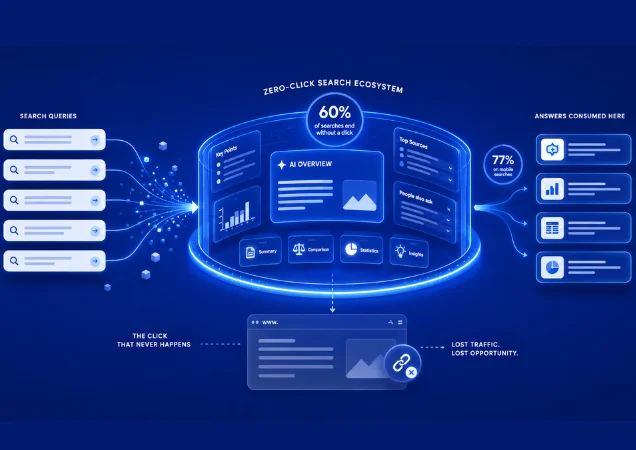
60% of all Google searches now end without a click. On mobile, that figure is 77%. In Google's AI Mode, it reaches 93%.
And 73% of B2B websites experienced significant organic traffic loss between 2024 and 2025, despite stable or improving rankings.
This is not a temporary dip. It is a structural shift, and most content teams are still measuring performance with tools that cannot see it.
What "Zero-Click Search" Actually Means in 2026
Zero-click search is defined as: a query resolved entirely within the search results page, without the user clicking through to any external website.
The user gets the answer. The search engine keeps the session.
Searches for "zero-click strategy" surged 180% between 2024 and 2025, signaling that marketing teams are waking up to the problem. But awareness has not translated to action for most.
Two forces drove the structural shift:
- AI Overviews, Google's AI-generated answer summaries now appear in over 25% of all U.S. desktop queries
- AI-native platforms, ChatGPT, Perplexity, and Gemini handle full research sessions by design, with zero-click rates between 60% and 93%
The result:
- More impressions
- Fewer visits
- Stable rankings, collapsing clicks
BrightEdge reported a 49% year-over-year rise in search impressions in May 2025, alongside a 30% drop in average click-through rates.
More people saw brands. Fewer arrived.
That single data point captures the zero-click economy.
The Data: Traffic Decoupling from Rankings
Most marketing dashboards surface the symptom, not the cause.
Traffic is down. Rankings are stable. The gap between those two facts is where the zero-click problem lives.
| Metric | What It Shows | What It Hides |
|---|---|---|
| Organic sessions | Site visits are declining | Impressions may be rising simultaneously |
| Keyword rankings | Position held steady | CTR from that position collapsed |
| Bounce rate | User behaviour on-site | Users who never arrived at all |
| Conversions | Actions taken on-site | Demand influenced before the visit |
| Page views | Content consumed on-site | Content consumed inside the SERP |
This is not a rankings problem. It is a revenue attribution problem.
Traffic and pipeline are decoupling. Brands can have growing search visibility and shrinking inbound volume at the same time.
When an AI Overview appears, organic CTR drops 61%, even for position 1. Position 1 results see 34.5% fewer clicks.
A ranking did not change. The value of that ranking did.
The clicks did not disappear. They moved.
Some went to Google-owned surfaces. Some to paid results. A growing share went to AI platforms that deliver answers without any outbound link.
Why Your Old SEO Playbook Is Making It Worse
The content most exposed to zero-click displacement is top-of-funnel informational content.
88.1% of queries triggering AI Overviews are informational (Ahrefs, 2025).
These are the "what is X" and "how to do Y" articles B2B teams have produced for years. The explainers. The guides. The awareness-stage blogs.
AI Overviews now answer them. On the SERP. Before anyone clicks.
Three Practices That Accelerate the Damage
1. Publishing for keyword volume without checking query intent
Long-tail, question-style queries trigger AI Overviews far more often than shorter queries.
Teams optimizing for high-volume head terms are producing exactly the content AI Overviews are built to answer directly.
2. Measuring content success by pageviews alone
When sessions define success, teams publish more of the content most exposed to zero-click erosion.
The editorial calendar fills with informational articles that AI Overviews handle completely, without sending traffic back.
3. Ignoring off-site presence entirely
Only 1% of users click on sources cited within AI Overviews.
But being cited still builds brand familiarity at the moment of research. Teams with no systematic off-site presence miss the channel that feeds both AI citation and brand recall simultaneously.
At LexiConn, we see this consistently. Content strategies built entirely around owned-page traffic have become structurally misaligned with how B2B buyers research in 2026.
The fix is not producing less content. It is producing different content, measured differently.
The Friction Shift Paradigm
Zero-click search is not just an SEO problem. It is a buyer journey problem.
The Friction Shift Paradigm describes what changed: the effort that users once spent deciding which search result to click has been eliminated. The answer is already there.
Old Search Journey vs Zero-Click Journey
| Stage | Old Journey | Zero-Click Journey |
|---|---|---|
| Awareness | Organic result clicked | Brand appears in AI-generated answer |
| Consideration | Multiple site visits | AI comparison consumed on SERP |
| Intent | Return visit or form fill | Direct branded navigation |
| Conversion | On-site path | Influenced by pre-click research |
For B2B buyers, the implication is significant.
A marketing manager evaluating content agencies no longer visits six websites to compare positioning. They ask ChatGPT, read a synthesized comparison, shortlist two names, and navigate directly to those sites.
The click happens, but after intent is already formed.
What This Changes for Content Strategy
Old model:
- Capture attention at the click
- Drive the user to a page
- Influence intent on-site
Zero-click model:
- Appear in the AI answer that shapes the shortlist
- Influence intent before any click occurs
- Convert a buyer who already knows you when they arrive
The pipeline contribution is real. The attribution path is broken.
At LexiConn, we use SEO for AI to optimize and scale growth.
What to Track Instead of Pageviews
A 30% decline in sessions means something entirely different if:
- Branded search volume grew 40%
- AI citation share doubled
- Sales-influenced conversions increased
All three represent marketing success. None show up in a session's dashboard.
Five Metrics That Actually Matter
1. Impressions in Search Console, not just clicks
Rising impressions alongside falling CTR is the zero-click signature.
Visibility is growing. Traffic is not following. That is a measurement problem, not a content problem.
2. Branded search volume
When users see a brand in an AI Overview, many search directly for that brand name later.
Track branded query growth in Search Console monthly. It is the clearest leading indicator of zero-click intent building at the bottom of the funnel.
3. AI citation share
Test the 10 most important buyer queries monthly across ChatGPT, Perplexity, and Google AI Overviews.
Track whether the brand appears, how it is framed, and which competitors show instead.
This is the zero-click equivalent of keyword rankings. See how Generative Engine Optimization determines AI citation, and how to build for it.
4. Direct traffic trends
Users who see a brand in an AI answer often visit directly afterward.
Spikes in direct sessions that correlate with zero-click visibility changes signal on-SERP exposure is influencing intent.
5. Conversion rate by source
AI-referred traffic converts at 4.4x the rate of traditional organic.
A smaller volume of high-quality visits outperforms a larger volume of low-intent sessions. Track quality, not just quantity.
Building a Zero-Click-Resilient Content Engine
The answer to zero-click is not to stop producing content.
It is to build content that creates value with or without the click.
1. Shift Investment Toward Citation-Ready Formats
The most resilient content is content AI systems must cite, not summarise.
This means:
- Original research and proprietary data
- Named frameworks with specific methodologies
- Benchmark reports with statistics that do not exist elsewhere
When content contains data no one else has, AI systems cite the source by name.
That citation is a branded mention in the answer, not a click, but authority at the moment of research.
2. Rebalance the Editorial Calendar Toward Mid-Funnel
B2B evaluation content shows 50 to 60% zero-click exposure. Informational content can reach 83%.
Content that helps buyers compare, evaluate, and decide is more resilient than content that educates broadly.
Common pattern:
- Most enterprise calendars are 70 to 80% top-of-funnel
- This is exactly where zero-click displacement is highest
- Shifting 30% toward evaluation content changes the exposure profile entirely
3. Build Owned Audience Channels
Email lists, newsletters, and communities are channels that zero-click cannot touch.
When a user subscribes after seeing a brand in an AI Overview, the relationship moves off-SERP into an owned channel.
No algorithm can disrupt a direct subscriber relationship.
4. Treat LinkedIn and YouTube as Discovery Channels
YouTube overtook Reddit as the top-cited source in AI-generated answers in early 2026.
LinkedIn content from named individuals with verifiable credentials builds entity association, the signal that makes a brand more likely to appear in AI answers.
For B2B brands:
- Founder content on LinkedIn is not a vanity exercise
- It is an AI citation and brand discovery strategy
5. Restructure Content for On-SERP Accuracy
If users are reading content on the SERP without clicking, what they read must be accurate and well-branded.
This means:
- Leading each article with a 40 to 50-word direct answer block
- H2s phrased as the exact questions buyers ask
- Brand name and positioning in sections most likely to be extracted
Being cited incorrectly in an AI Overview is worse than not being cited at all.
Control the framing by controlling the extractable content.
LexiConn's content audit services now include a zero-click readiness layer, evaluating whether content creates value on-SERP, not just on-site.
The CFO Conversation: Defending Content Spend Without Traffic Numbers
The Problem
Traffic is down 25%. The CFO wants to know why the content budget is not being cut.
The answer requires reframing what content is measuring, and what it is actually doing.
Three Data Points That Change the Conversation
- Branded search volume grew 18% in the same period, traffic declined, users are encountering the brand through AI Overviews and searching directly afterward
- AI-referred sessions converted at 4.4x the rate of standard organic traffic, pipeline per session is significantly higher
- Several deals in the period cited specific content the buyer consumed, without clicking through to the site
The shift is from:
"How much traffic did content drive?"
To:
"How much pipeline did content influence?"
How to Make This Shift
This requires:
- Connecting content activity to CRM data, not just Google Analytics
- Tracking "how did you hear about us?" in onboarding calls
- Patience, the attribution chain in a zero-click world is longer and less linear
The attribution path is broken. The pipeline contribution is real.
Document it differently.
The Future Outlook: Where Zero-Click Search Goes Next
Three forces will intensify the zero-click reality over the next 12 to 18 months.
AI Mode Expands
Google's AI Mode is currently in limited rollout. When it scales, queries handled end-to-end inside the SERP will increase significantly.
The brands that are building GEO-ready content now will have a structural advantage when that happens.
Multimodal Search Changes the Citation Mix
As AI search expands into voice, image, and video, the content types that earn citations will diversify.
Brands that have only optimised for written blog content will need to extend their citation strategy to video transcripts, podcast summaries, and visual explainers.
Measurement Standards Will Emerge
The industry does not yet have a standard for AI citation tracking. That will change.
The teams that build internal measurement systems now, AI referral tracking, citation share audits, branded search baselines, will be ahead when industry benchmarks arrive.
Where to Start Tomorrow Morning
Zero-click is not a problem to solve once. It is a condition to build for continuously.
Week 1: Run a Zero-Click Exposure Audit
Open Google Search Console. Pull the top 50 pages by impressions. Calculate CTR for each.
Pages with high impressions and low CTR are the zero-click exposure list.
Ask:
- Is the on-SERP content accurate and well-branded?
- Does it reflect current positioning?
- If not, restructure it
Week 2: Set Up Branded Search Tracking
In Search Console, filter queries containing the brand name.
Set a monthly tracking cadence. This is the leading indicator of whether zero-click visibility is building intent.
Week 3: Audit One Page for AI Extraction
Take the highest-impression, lowest-CTR page.
Restructure the opening 200 words as a direct answer. Add a FAQ section. Submit for FAQ schema.
Test it in ChatGPT and Perplexity. Document what the AI says.
That is the baseline.
Month 2 to 3: Build Toward Citation Equity
- Commission one piece of original research or proprietary benchmark data
- Audit presence on G2, Capterra, LinkedIn, and industry publications
- Build a systematic plan for third-party mentions in the places AI systems read
Teams that want to evaluate their full content ecosystem should start with a structured content audit before building a zero-click strategy.
Conclusion
Zero-click search is not a crisis. It is a recalibration.
The brands that win are not the ones that rank highest. They are the ones that appear in the answer, with the right framing, at the right moment.
That requires different content. Structured differently. Measured differently. Distributed across channels that no algorithm can zero out.
The click is no longer the beginning of the relationship. In many cases, it is the confirmation.
Build for that.
Key Takeaways
- 60% of Google searches end without clicking
- AI Overviews collapse CTR even at position one
- Top-of-funnel content faces highest displacement risk
- Pipeline influence matters more than session volume
- Build citation equity before zero-click compounds further
FAQs
1. Is my traffic decline caused by zero-click search or a Google penalty?
If rankings are stable but traffic has fallen, zero-click is the most likely cause. Penalties drop rankings first, then traffic. Check Search Console, rising impressions alongside falling CTR confirm the zero-click pattern, not a penalty.
2. Should B2B companies stop producing top-of-funnel content?
No, reduce volume, improve quality, and shift format. Generic informational content is replaced by AI summaries. Proprietary data, named frameworks, and expert-authored depth are not. Rebalance the calendar; do not stop publishing.
3. How should marketing leaders report content ROI when traffic is declining? Connect content to the pipeline, not sessions. Track branded search growth, AI citation share, and sales-assisted conversions. Supplement with onboarding call data, "how did you hear about us?" surfaces influence that analytics alone cannot capture.
4. How does zero-click search affect BFSI content specifically?
BFSI queries, interest rates, compliance terms, product comparisons, have strong AI Overview coverage. Compliance-accurate, expert-attributed content earns those placements. Content that fails YMYL standards is excluded from AI Overviews entirely.
Q5. Is there content that is immune to zero-click displacement?
Branded navigational queries and high-consideration evaluation content are most resilient. Proprietary benchmark data cannot be summarised away, it does not exist elsewhere. This is the highest-return content investment in a zero-click environment.
Sources:
Need expert content support? LexiConn has been India's B2B content partner since 2009, building content systems for leading enterprise brands across BFSI, technology, and media. Explore our content strategy services →