
Founder Air Cover: How Thought Leadership Warms Cold Outbound and Helps Your SDRs
Most B2B cold emails still see only 1, 5% reply rates. In India’s crowded SaaS market, prospects are tired of unknown senders and generic outreach.
But something changes when they recognize the founder behind the company.
A prospect who ignores a cold email today might respond tomorrow after seeing the founder’s LinkedIn posts, industry takes, or customer insights in their feed. The outreach suddenly feels less cold, even though the SDR’s message hasn’t changed.
That’s what a strong founder “air cover” does.
Companies with visible founder-led thought leadership often move deals faster because trust starts building before the first sales conversation. Air cover is the marketing narrative that quietly warms buyers in the background while SDRs handle outreach on the front lines.
This blog breaks down how founders can create that air cover on LinkedIn, synchronize it with SDR outreach, and measure the impact through a practical 60-day pilot.
The Cold Outbound Crisis in Indian B2B SaaS
Indian SDR teams are working against brutal odds.
Most B2B cold emails still see reply rates of barely 1, 5%. Even with good targeting and decent copy, only a small percentage of decision-makers respond. One SaaS case study found that SDRs sending nearly 800 emails a week were booking just 8, 10 meetings. At that pace, outbound quickly becomes exhausting for both the sales team and the prospect.
This is why many SDR teams today feel stuck in a cycle of endless follow-ups, low replies, and constant rejection.
The challenge is even sharper in India’s SaaS ecosystem. LinkedIn now has more than 100 million users in India, making it one of the platform’s largest professional markets globally. At the same time, only a small percentage of users post consistently every week. Most founders stay invisible while thousands of SDRs compete for the same buyer attention.
As a result, most outbound messages arrive without context.
The prospect sees a random company name, an unfamiliar SDR, and another sales pitch in an already crowded inbox. Their first reaction is usually simple: “Who are these people?”
That lack of familiarity is where outbound breaks down.
Without strong founder visibility, SDR outreach feels completely cold. There is no trust layer before the first message arrives. No prior recognition. No narrative is already forming in the buyer’s mind.
This is where the founder's air cover changes the equation.
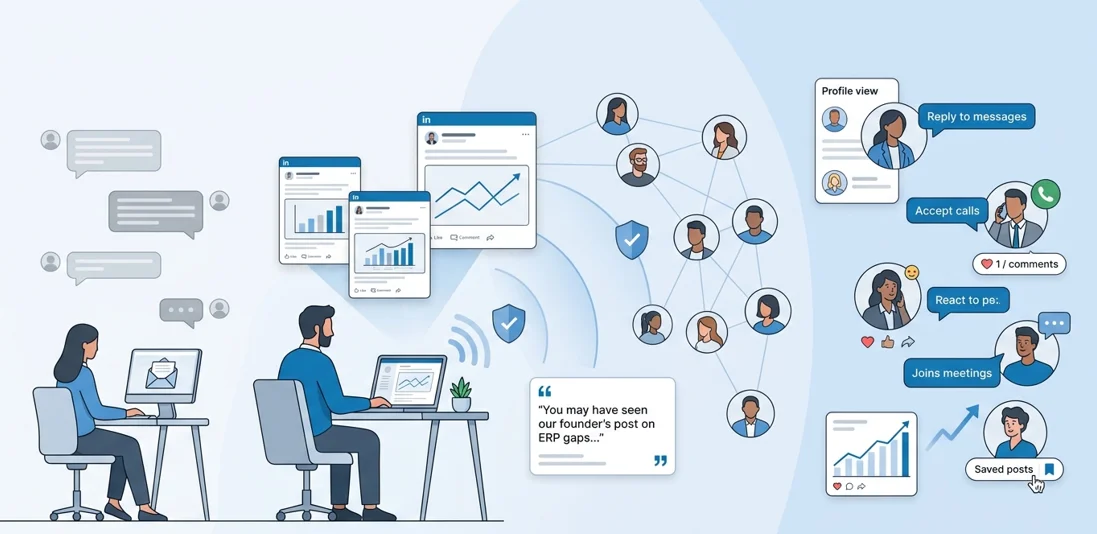
Air cover is the visibility and credibility a founder builds publicly before the SDR ever reaches out. It creates familiarity at scale. So when prospects receive a connection request or email, they are not encountering the company for the first time. They already recognize the founder’s name, opinions, or content from LinkedIn.
That small shift changes how buyers respond to outreach.
| Metric | Without Founder Air Cover | With Founder Air Cover |
|---|---|---|
| Cold email reply rate | 1, 3% average replies | Higher engagement due to familiarity |
| Meetings booked | Low conversion from outreach | More conversations from warmed prospects |
| Sales cycle length | Longer, trust must be built from scratch | Shorter because credibility already exists |
| SDR workload | Heavy follow-ups and repeated nudges | Easier conversations and warmer replies |
| Buyer perception | “Unknown vendor” | “I’ve seen this founder before” |
The SDR still does the outreach. The founder is not replacing sales.
But strong LinkedIn thought leadership makes outbound feel less like an interruption and more like a continuation.
What “Air Cover” Actually Means
In B2B marketing, air cover is the strategic thought leadership layer that warms up target accounts before any direct sales outreach. Just like military air support protects ground troops, founder-led content builds awareness and credibility so SDRs aren’t starting from zero.
Air cover is not advertising. It is the narrative layer that makes your company feel familiar before the first sales conversation. It includes LinkedIn posts, comments, and insights that show prospects you understand their world and their problems. When done well, it turns cold outreach into warm conversations because prospects think, “I’ve seen this perspective before.”
What Strong Air Cover Actually Does
It positions the founder as someone worth listening to, long before a pitch happens. It works as a trust signal that reduces resistance in sales conversations.
In simple terms, air cover \= “pre-built credibility in the buyer’s mind.”
In military terms, founders act as the strategic reconnaissance layer that identifies signals in the market and guides SDRs toward the right targets with context, not cold guessing.
Three key elements of strong air cover:
- Authority: Strong air cover is built on real experience. Case studies, data-backed insights, and honest reflections on failures matter more than polished opinions. This is what signals expertise, not performance.
- Relevance: Content must speak directly to your ICP. Generic advice gets ignored. Focused insights get remembered. While only a small percentage of LinkedIn users post regularly, that minority drives disproportionate attention and impressions across the platform.
- Integration: Marketing and sales must tell the same story. When SDR outreach aligns with the founder’s content, prospects experience consistency. That recognition increases trust and response rates.
Air cover is not about reach or virality. It is about pre-framing trust.
The Three-Phase Warming Sequence
This sequence describes what happens when the founder’s air cover is actually working. It is not a rigid workflow to execute step by step. It is the pattern that naturally emerges when founder content and SDR outbound targeting are properly synchronized.
Phase 1: Cold Connection
The prospect sits on the SDR’s target account list with zero prior exposure to the founder or the company. At this stage, every outbound action is happening in isolation.
- SDR sends connection requests or cold messages
- Prospect has no context or familiarity
- Acceptance and reply rates are low
This is the baseline reality for most B2B SaaS SDR teams.
The goal here is not to close a deal or even start a conversation. The only objective is to get the connection accepted. That single action unlocks future visibility. Once connected, LinkedIn can surface the founder’s content in the prospect’s feed through weak network signals and shared engagement patterns.
Phase 2: Founder Air Cover
Once connected, the prospect begins to encounter the founder’s content over time. This does not happen in one channel. It happens through multiple reinforcing pathways.
- The LinkedIn algorithm surfaces founder content through mutual connections
- SDRs reshare founder posts, increasing feed exposure
- Some prospects organically follow the founder after a strong post
This phase does real trust building.
Each content touch adds a layer of familiarity:
- A relevant post creates recognition of a problem
- A useful insight builds credibility
- A saved carousel signals strong intent and resonance
By the time a prospect has engaged with or saved two or more posts, they already hold an implicit opinion of the founder. That perception becomes one of the most valuable inputs in the SDR process.
This phase cannot be rushed. It typically requires two to four weeks of consistent posting before it begins to meaningfully influence a specific account set. That is why founder content must start before outbound sequencing, not alongside it.
Phase 3: Warm Engagement
Now SDR follow-ups enter a completely different context.
The prospect may not remember every post, but they recognize the name or the company. The outreach no longer feels random. It feels familiar.
- Reply rates increase because cognitive friction drops
- Messages feel like continuations, not interruptions
- Meetings become easier to initiate
At this stage, referencing founder content directly becomes a high leverage tactic.
For example:
- “You may have seen Rajesh’s post on ERP implementation gaps. The issue he described is exactly what we solve.”
This creates a bridge between content exposure and commercial conversation. It turns passive awareness into active engagement.
The power of this sequence is not in timing alone. It is in reinforcement.
Cold outreach creates exposure. Founder content creates familiarity. Follow up converts that familiarity into conversation.
When all three are aligned, SDR outreach stops feeling cold and starts feeling expected.
How a Prospect’s Behavior Changes When They Recognize the Founder
When a prospect sees the founder’s name or face in their feed before any sales outreach, their response pattern changes in a measurable way. Recognition reduces resistance and increases trust, which directly impacts how they engage with SDR outreach.
Research shows that 78% of social sellers outperform those who do not use social at all. This highlights a simple truth: visibility builds advantage before the conversation even starts.
At a broader level, 86% of B2B decision makers say thought leadership content influences their purchasing decisions. In practice, this means buyers are already forming opinions before sales outreach ever lands.
What Changes in SDR Conversations
When recognition is present, SDR outreach is no longer perceived as a cold interruption.
Instead of:
- “Cold outreach from a stranger”
It becomes:
- “A follow-up from a company I have already seen”
This shift changes the entire dynamic of the conversation. The SDR is no longer introducing the company from scratch. They are continuing a narrative that the prospect has already been exposed to.
This creates what can be called implicit pre-qualification. Prospects are more open to the call, and they tend to ask sharper, more relevant questions. This reduces time spent on basic context building and shortens the qualification stage.
Some industry reports, such as Foundera analyses, suggest that strong founder-led content can reduce sales cycle length by around 30% because prospects enter the pipeline with existing familiarity.
Impact on Response Quality
Recognition does not just improve reply rates. It changes the quality of engagement.
When a rep consistently shows up in a prospect’s feed through founder content, they are no longer treated as a new voice. This leads to faster trust formation and more meaningful conversations.
In practice, reps with strong social presence and content visibility often generate significantly more opportunities and are more likely to hit quota, as seen in studies around higher LinkedIn Social Selling Index performance.
Synchronizing Founder Content with the SDR Motion
Founder air cover works best when the founder’s content strategy aligns closely with the SDR team’s outreach efforts. This should operate as a coordinated partnership, not as separate sales and marketing functions.
Calendar Alignment
Before launching a major SDR campaign such as a product launch, quarter push, or vertical expansion, align on the target audience and timeline. The founder can then publish content that speaks directly to that audience’s challenges and priorities.
For example, if SDRs plan to target fintech companies in June, the founder should start sharing fintech-focused insights in late May to build familiarity before outreach begins.
Shared Intelligence
SDRs often uncover recurring objections and market concerns. These insights should be shared with the founder through CRM notes, Slack channels, or regular syncs.
If prospects repeatedly mention budget concerns around AI adoption, the founder can address those concerns through LinkedIn posts, articles, or videos that educate and build credibility.
Engagement-Led Outreach
The founder should actively respond to comments and engagement on posts. When prospects from target accounts interact with content, SDRs gain a natural and contextual outreach opportunity.
A message like, “I noticed you engaged with our post on data privacy,” feels far warmer and more relevant than a cold introduction.
Consistent Messaging
The founder’s content pillars should reinforce the same problems and value propositions SDRs are discussing in outreach.
If the company’s differentiator is ease of integration, the founder should consistently create content around simplifying enterprise integrations and reducing implementation friction.
When founders and SDRs work in sync, outreach becomes more credible, conversations become warmer, and thought leadership translates directly into a qualified pipeline.
What Founders Should Publish to Maximise SDR Support
Not all founder content creates effective air cover. Personal updates, motivational posts, or internal company celebrations may build familiarity, but they rarely help SDRs start meaningful sales conversations.
The most effective content makes prospects think, “This person understands my world.”
| Content Type | Air Cover Strength | Why It Works |
|---|---|---|
| Industry-specific problem analysis | High | Prospects recognise their own challenges |
| Client case studies or measurable outcomes | Very High | Demonstrates proven results in the target sector |
| Contrarian industry perspectives | High | Memorable and highly shareable |
| Frameworks or decision tools for the ICP | Very High | Valuable enough for prospects to save and revisit |
| Personal founder stories unrelated to the ICP | Low | Builds familiarity but lacks commercial relevance |
| Company updates or product announcements | Low | Often feels promotional rather than insightful |
| Generic motivational content | Very Low | Difficult to differentiate from other posts |
Content Formats That Strengthen Outbound
The “I saw this in a client call last week” post
Share a specific observation from a recent customer conversation, while keeping details anonymous if needed. This signals strong market awareness and helps prospects feel understood.
The “why this common approach fails” post
Challenge a widely accepted industry practice and explain why it leads to poor outcomes. This format works well because it demonstrates expertise and a clear point of view.
The sector-specific data post
Use a relevant industry statistic and add an interpretation around what it means for business planning or operations. Data paired with insight is far more compelling than data alone.
The client’s result post
Even a short example of a measurable customer outcome can significantly strengthen SDR outreach.
For example: “A Hyderabad-based logistics company reduced dispatch errors by one-third within six weeks of implementation.”
This gives SDRs a credible and contextual reference point during outreach, making conversations feel warmer and more relevant than a standard product pitch.
A 60 Day Pilot to Measure the Impact
The case for founder air cover is intuitive, but B2B SaaS teams need proof, not theory. This pilot is designed to test the impact in a controlled way without changing the entire sales system.
Week 1 to 2: Setup
The founder and SDR lead selected one clear target segment for the experiment. This should be a single industry vertical and one job title that the SDR team is already actively pursuing. This becomes the pilot cohort.
The founder commits to posting three times per week for 60 days. At least two of these posts each week should directly address problems, patterns, or insights relevant to the chosen ICP.
The SDR team exports the target account list for this cohort and tags it in the CRM as a pilot group. During the first two weeks, no outbound messages are sent to this cohort. This pause allows initial content exposure to build before outreach begins.
Week 3 to 8: Outbound with Air Cover
From week three, SDR outreach begins for the pilot cohort.
- Connection requests are timed to follow founder posts within the previous 48 hours
- SDRs prioritize accounts that have already shown early signals of engagement with founder content, such as likes, comments, profile visits, or shares
- These engaged accounts are moved higher in the outreach sequence
- SDR messages explicitly reference the founder’s content when relevant
All standard sales metrics are tracked during this period, including:
- Connection acceptance rate
- Reply rate on first message
- Meeting booking rate
- Show rate
The key difference is that every interaction is now layered on top of prior content exposure.
Day 60: Measurement
At the end of 60 days, compare the pilot cohort’s performance against the baseline data from the 60 days prior to the experiment.
Focus on:
- Connection acceptance rate: Did visibility improve initial acceptance?
- Reply rate: Did familiarity increase responsiveness?
- Meeting booking rate: Did more conversations convert into meetings?
- Content-engaged accounts: What percentage of prospects who engaged with founder content converted into meetings compared to those with no exposure?
What to do Tomorrow Morning
Tomorrow, map your SDR targets and pick one key audience or vertical. Have your founder write one LinkedIn post that addresses a top frustration of that group. At the same time, brief your SDRs to mention that post in their next outreach. Meet on Day 7 to compare notes: did any prospect react to it?
By next week, schedule at least two more posts. Measure LinkedIn profile views and any uptick in responses after Day 14. Keep iterating.
Remember: Your LinkedIn isn’t just another social channel; it’s a demand engine. Air cover from founder thought leadership primes your SDR team and makes every outreach easier. Start building that cover now, your pipeline will thank you.
Key Takeaways
- Founder air cover makes cold outreach feel familiar
- Prospects respond more when they recognize the founder
- Founder content should align with SDR messaging
- Industry insights outperform generic LinkedIn posts
- Consistent visibility can improve replies and meetings
FAQs
1. What does “founder air cover” actually mean?
Founder air cover is the trust and familiarity created through consistent founder-led content before SDR outreach begins. It helps prospects recognize the company, understand its perspective, and engage more openly when sales conversations start.
2. Why does founder visibility improve SDR performance?
Prospects are naturally more responsive to companies they recognize. When buyers have already seen a founder’s insights or industry commentary on LinkedIn, SDR outreach feels less like a cold interruption and more like a continuation of an existing narrative.
3. What kind of founder content helps outbound the most?
The highest-performing content is usually:
Industry-specific problem analysis
Customer observations
Contrarian insights
Frameworks for the ICP
Real customer outcomes and lessons
The common trait is specificity. Prospects engage more with content that reflects their actual business challenges.
4. Does founder air cover replace SDR outreach?
No. Founder content supports outbound; it does not replace it. SDRs still drive conversations, qualification, and pipeline creation. Air cover simply makes those conversations easier to start because familiarity already exists.
5. How long does it take for founder air cover to influence the pipeline?
In most cases, meaningful impact starts appearing after two to four weeks of consistent posting and aligned SDR outreach. Trust compounds gradually through repeated exposure, not through a single viral post.
Sources:
- https://smtpmaster.com/blog/b2b-cold-email-response-rates-proven-strategies-to-boost-engagement-in-2025/#:\~:text=What%20is%20a%20good%20B2B,email%20response%20rate%20in%202025
- https://www.punchb2b.com/blog/why-your-sdrs-personal-brand-is-now-a-pipeline-asset#:\~:text=B2B%20www,more%20reach%20than
- https://www.reddit.com/r/B2BSaaS/comments/1t4ggn7/indian_founders_and_linkedin_are_we_leaving_money/#:\~:text=Data%20point%201,LinkedIn%27s%20own%20research%2C%202025
- https://www.foundera.co/blog/founder-led-linkedin-growth#:\~:text=According%20to%20Foundera%E2%80%99s%20client%20data,following%20the%20founder%E2%80%99s%20thought%20leadership
Need expert content support? LexiConn has been India's B2B content partner since 2009, building content systems for leading enterprise brands across BFSI, technology, and media. Explore our thought leadership services →