
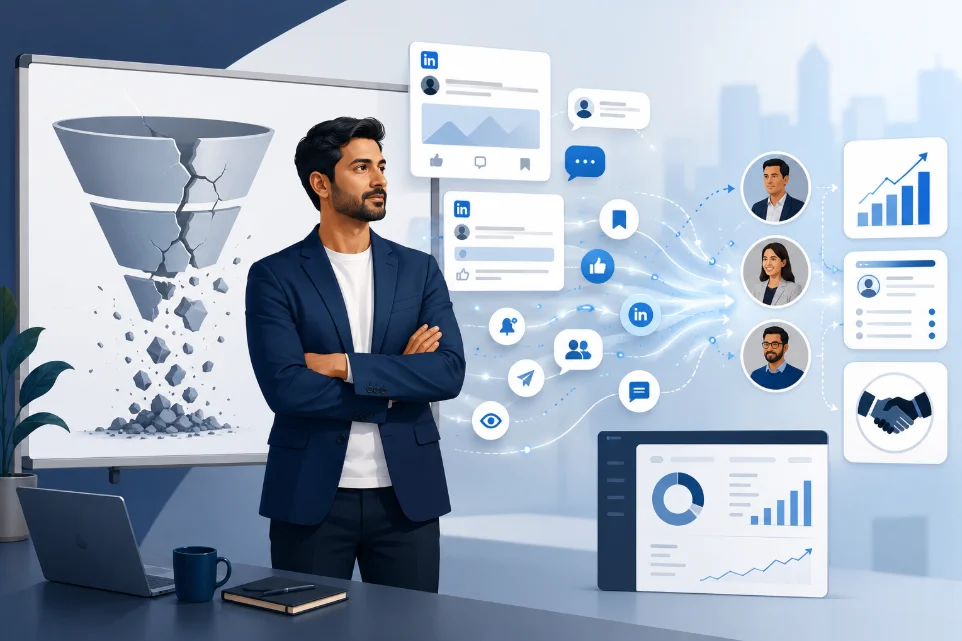
Brand vs. Demand is a False Dichotomy: The Founder's Reputation IS the Demand Engine
At every B2B marketing planning session, someone eventually draws the funnel on the whiteboard. Brand at the top. Demand at the bottom. Separate budgets, separate teams, separate goals. It is a familiar model. It is also increasingly outdated for 2026.
Research from the LinkedIn B2B Institute, based on work by John Dawes of the Ehrenberg-Bass Institute, found that 95% of B2B buyers are not actively in-market at any given time. They are not filling out forms or booking demos. They are watching, scrolling, and forming opinions about which companies and founders feel credible before the need to buy even appears.
That is why the old “brand versus demand” split no longer holds up. On LinkedIn, a founder’s reputation now does both jobs at once. Every thoughtful post builds familiarity, trust, and future demand while also influencing buyers who are ready today. In 2026, founder visibility is not just a brand asset. It is the demand engine itself.
The Legacy Funnel and Why it Stopped Working
The traditional AIDA-style funnel, where the brand creates awareness first and demand captures buyers later, no longer reflects how B2B buying actually works. Yet many companies still split budgets rigidly between “brand” and “demand,” as if they operate independently. In reality, modern buyers move fluidly between both.
One recent industry analysis summed it up clearly: the companies winning in 2026 are not choosing brand or demand. They are learning how to make both work together. That shift matters because siloed marketing creates predictable gaps. Brand campaigns often generate visibility without commercial intent, while demand teams end up chasing cold prospects with little trust or familiarity.
Platforms like LinkedIn have collapsed that separation. Buyers now evaluate companies continuously through the people behind them. Research shows 82% of B2B buyers are influenced by the expertise and visibility of a company’s leadership team. A founder’s reputation is no longer separate from the funnel. It actively shapes it.
This is why founder-led visibility has become so powerful. A thoughtful LinkedIn post can build brand memory, create trust, warm up future buyers, and generate inbound demand at the same time. Even LinkedIn case studies have shown that increasing investment in brand-building activity can strengthen pipeline and SQL generation rather than weaken it. The old silos created friction. Founder-led reputation reduces it.
What Changed in the AI Era
LinkedIn’s 2025, 26 algorithm rewrite, often referred to as “360 Brew,” changed the platform completely. The feed is now AI-driven. Instead of simply rewarding reach or surface-level engagement, LinkedIn now analyses posts contextually using large language models.
This means the algorithm looks for signals like:
- Topic clarity
- Relevance to a specific audience
- Likelihood of generating dwell time and saves
- Practical value readers can return to later
In simple terms, LinkedIn now rewards content that people actually spend time with.
A major shift is how heavily the opening lines matter. The platform reportedly analyses roughly the first 200, 250 characters of a post to understand:
- What the post is about
- Who it is for
- Whether there is a clear payoff for reading further
That is why generic motivational content and vague company updates are losing visibility. Posts without specificity are increasingly treated as low-value content.
What is performs now is:
- Founder lessons
- Clear opinions
- Practical workflows
- Contrarian insights
- Industry breakdowns
- Saveable content like carousels and frameworks
This shift is even more important in India’s B2B market. Very few LinkedIn users post consistently, yet that small group captures an outsized share of impressions and attention. Most SME founders are still passive observers on the platform, which means authentic founder-led content stands out immediately.
Indian audiences have also become extremely good at spotting generic AI-written posts. They can quickly tell the difference between recycled internet advice and insights from someone who has actually built, sold, operated, or solved something in the real world.
That is why the AI era is favouring founder-led visibility. The algorithm now amplifies credibility, specificity, and lived experience, not polished corporate messaging. In 2026, trust-building content from founders consistently outperforms brand-heavy content designed by committee.
The Founder Reputation as a Unified Brand-Demand Asset
A founder’s reputation is no longer just a branding asset. In 2026, it has become the mechanism that drives both brand awareness and demand generation at the same time.
At its core, founder reputation is the accumulated set of beliefs an audience forms about a person’s expertise, judgment, and credibility through repeated exposure over time. Every LinkedIn post, comment, interview, customer insight, or opinion shapes that perception. Unlike traditional brand campaigns, this visibility does not rely heavily on paid distribution. Unlike demand generation tactics, it does not require forms, gating, or aggressive lead capture. It compounds naturally.
Consider what happens when an Indian B2B SaaS founder shares one sharp, experience-driven LinkedIn post every week for a year.
- The 95% of buyers who are not actively purchasing today begin recognising the founder’s expertise.
- Over time, they develop familiarity with the company, its thinking, and its positioning.
- When those buyers eventually enter the market, the founder is already mentally shortlisted.
That is brand building.
At the same time:
- Some readers are already in-market.
- They respond directly through DMs, profile visits, referrals, or inbound enquiries.
- Sales conversations begin with trust already established.
That is demand generation.
The important shift is that both outcomes come from the same activity, the same channel, and largely the same investment of time. Founder-led LinkedIn visibility collapses the old separation between brand and demand because buyers now experience both simultaneously.
| Funnel Stage | Legacy Brand-Demand Split | Founder Reputation Model |
|---|---|---|
| Awareness | Paid reach through ads, events, sponsorships | Organic founder content and dark social sharing |
| Consideration | Whitepapers, nurture emails, retargeting | Buyers exploring the founder’s post history and opinions |
| Intent Signal | Form fills, MQL scoring, SDR outreach | Inbound DMs from already-warmed prospects |
| Decision | Sales decks and objection handling | Faster trust and shorter sales cycles |
| Attribution | Incomplete first-touch or last-click models | “I’ve been following your posts for months” |
This is something the old funnel structure struggled to achieve. Brand and demand operated through different teams, different formats, and different timelines. The founder's reputation changes that completely. One consistent stream of credible content now influences awareness, trust, intent, and conversion together.
How a Strong Founder Profile Shortens the Sales Cycle
The impact of founder visibility is not just about reach or engagement. It directly affects how quickly buyers move through the sales process.
When founders consistently share useful insights, operational lessons, customer observations, and clear opinions on LinkedIn, prospects often arrive already familiar with the company and trusting its expertise. Instead of starting from zero credibility, sales conversations begin with pre-built confidence.
Many founder-led B2B teams describe the same pattern:
- Prospects already know what the company stands for
- Buyers feel they “understand” the founder before the first call
- Objections are reduced earlier in the process
- Sales teams spend less time establishing trust
In practical terms, the founder’s content does part of the selling before the SDR or sales rep even enters the conversation.
This becomes especially powerful in India’s B2B ecosystem, where trust and credibility heavily influence buying decisions. Buyers are far more likely to engage when they consistently see a founder demonstrating expertise publicly rather than relying only on polished company messaging.
A common pattern among successful founder-led LinkedIn strategies is the shift away from generic content toward real operational insights:
- Product decisions
- Customer conversations
- Market observations
- Lessons from failures
- Contrarian opinions backed by experience
That type of content creates familiarity and authority simultaneously. As trust compounds, buyers move from awareness to decision much faster.
The pipeline impact can be significant:
| Metric | Traditional Company-Led Content | Founder-Led LinkedIn Strategy |
|---|---|---|
| Monthly Leads | 100 | 300 |
| Conversion Rate | 5% | 15% |
| Deals per Month | 5 | 45 |
| Revenue Impact (Index) | 1.0× | 3.5× |
The key insight is not just higher visibility. It reduces friction. Founder-led visibility warms the market continuously, which means by the time buyers reach out, much of the persuasion has already happened.
The Budget Reallocation: From Layered Funnel to Founder Amplification
The 2026 shift is not about eliminating demand generation. Performance marketing still matters because it captures buyers who are ready now. The real change is recognising that founder-led content is no longer just a brand activity. It is a demand creation asset.
Most B2B companies still spend heavily on capturing the small percentage of buyers already in-market while underinvesting in the much larger audience that will buy later. Founder visibility helps solve that gap because it builds trust continuously, not just at the point of conversion.
For Indian SMEs with limited budgets, this matters even more. Founder-led LinkedIn content compounds over time, costs far less than traditional paid distribution, and warms future buyers before the sales conversation even begins.
The recommended shift looks less like “brand vs demand” and more like reallocating spend toward trust-building channels that influence both.
| Activity | Old Allocation | 2026 Shift |
|---|---|---|
| Paid display and programmatic | 25, 30% | 10, 15% |
| Outbound SDR teams | 20, 25% | 10, 15% |
| Gated content and whitepapers | 15, 20% | 5, 10% |
| Founder content and LinkedIn organic | 0, 5% | 20, 25% |
| LinkedIn Thought Leader Ads | 0, 2% | 10, 15% |
| Communities and partnerships | 10, 15% | 20, 25% |
A major addition in this model is LinkedIn Thought Leader Ads. These allow founders to amplify their best-performing organic posts to highly targeted audiences. Instead of promoting polished corporate messaging, companies can scale content that already has trust and engagement built into it.
That is the real shift in 2026: moving budget from interruption-based marketing toward founder-led credibility that compounds over time.
Two Illustrative Indian B2B SME Examples
The impact of founder-led visibility becomes much clearer when viewed through real business scenarios.
Case A: B2B SaaS Company (₹10 Cr ARR)
A SaaS founder began posting twice a week on LinkedIn about specific customer problems their product solved. Instead of generic thought leadership, the posts included:
- Workflow screenshots
- Product decisions
- Operational lessons
- Measurable customer outcomes
After six months:
- Inbound demo requests from LinkedIn reportedly tripled
- The company began amplifying top-performing posts using LinkedIn Thought Leader Ads targeted at CFOs and finance leaders
- Average sales cycle reduced from roughly 60 days to 42 days
- The business closed several additional deals, creating meaningful new annual revenue
An unexpected benefit also emerged: stronger inbound hiring interest because potential candidates already trusted the founder’s expertise and company direction.
Case B: Engineering Manufacturing SME (₹5 Cr Turnover)
A manufacturing founder started sharing practical factory-floor insights and operational fixes on LinkedIn. The content was highly niche:
- Plant setup lessons
- Process improvements
- Common mistakes in manufacturing operations
- Contrarian views on efficiency and production
Despite the specialised subject matter, the posts began attracting strong engagement from Tier-2 business owners and plant operators.
Within a few months:
- Engagement increased significantly
- Warm inbound enquiries started arriving consistently
- Multiple conversations converted into purchase orders
- The company generated meaningful new business directly linked to the founder's visibility
The key insight from both examples is that founder content is no longer “awareness marketing.” It can be tied directly to pipeline, deal velocity, referrals, hiring, and revenue growth.
When founders consistently publish credible, experience-driven content, they reduce trust gaps before sales conversations even begin.
How to Defend This Shift to a Skeptical Board
The board’s objection is predictable: founder content does not fit neatly into traditional attribution models. There is no clear CPC, CPL, or MQL attached to a LinkedIn post, which makes it easy to dismiss as a soft branding exercise. But that is less a flaw in founder-led marketing and more a limitation of the measurement framework itself.
The first step is reframing how success is measured. Instead of focusing only on last-click attribution, track signals that reflect growing trust and market awareness. Look at branded search growth, direct traffic from target accounts, profile visits from decision-makers, and self-reported attribution on enquiry forms. Even a simple question like “How did you hear about us?” can reveal patterns traditional dashboards miss. When buyers repeatedly mention LinkedIn, founder posts, or say they have been following the founder for months, it becomes clear that visibility is influencing the pipeline long before conversion happens.
The second shift is to focus on deal quality and deal velocity rather than raw lead volume. An inbound enquiry from someone who has been reading a founder’s content for months behaves very differently from a cold lead generated through paid advertising. The trust already exists before the first sales call. That usually leads to faster conversions, higher close rates, and smoother sales conversations. Over time, these differences become measurable across pipeline and revenue metrics.
The third argument is the cost of doing nothing. Most B2B companies still spend the majority of their marketing budget targeting the small percentage of buyers already in-market, while underinvesting in the much larger audience forming future buying preferences. The result is rising acquisition costs, growing dependence on paid channels, and weaker brand trust over time. Meanwhile, competitors with visible founders continue compounding attention, familiarity, and credibility every week.
The important realization is that founder-led LinkedIn visibility is not competing with demand generation. It is demand generation, just in a form that traditional attribution systems were never designed to measure properly. The founder’s reputation builds awareness, trust, intent, and conversion simultaneously. In 2026, separating brand and demand is increasingly a budgeting habit, not a reflection of how B2B buyers actually make decisions.
Key Takeaways
- Founder visibility now influences both brand and pipeline
- LinkedIn’s AI feed rewards specificity and lived experience
- Trust-building content shortens B2B sales cycles significantly
- Founder-led content compounds at near-zero distribution cost
- Brand and demand are converging into one reputation engine
FAQs
1. Why is the traditional brand-versus-demand split becoming outdated in B2B marketing?
Modern B2B buyers do not move through a clean linear funnel anymore. Buyers continuously research companies, founders, and industry opinions long before entering a sales process. Founder-led visibility now builds awareness, trust, and purchase intent simultaneously, making the old separation between brand and demand less relevant.
2. Why does founder-led LinkedIn content perform better than company-page content?
Founder content feels more credible, specific, and experience-driven. Buyers trust operational insights, strong opinions, and customer lessons shared by real people far more than polished corporate messaging. LinkedIn’s AI-driven feed also prioritises content that generates dwell time, saves, and meaningful engagement, which founder posts naturally create more often.
3. How does founder visibility shorten the sales cycle?
When prospects consistently consume a founder’s content, trust is established before the first sales conversation happens. Buyers already understand the company’s positioning, expertise, and perspective. This reduces friction during discovery calls, lowers objections earlier, and improves conversion speed across the pipeline.
4. Should Indian SMEs reduce performance marketing budgets in 2026?
Not entirely. Demand generation still matters for capturing buyers already in-market. The shift is about rebalancing investment toward founder-led visibility and trust-building channels that influence future buyers earlier. Companies relying only on paid acquisition are becoming increasingly vulnerable to rising CAC and declining cold-response rates.
5. How can companies measure the ROI of founder-led LinkedIn content?
The most useful metrics are influenced pipeline, inbound enquiries, branded search growth, deal velocity, and self-reported attribution. Many buyers may never convert directly from a post but still enter the sales process later with strong founder familiarity. Tracking “How did you hear about us?” alongside CRM attribution often reveals the real commercial impact.
Sources:
- https://marketingscience.info/news-and-insights/ehrenberg-bass-95-of-b2b-buyers-are-not-in-the-market-for-your-products
- https://www.foundera.co/blog/founder-led-linkedin-growth#:\~:text=Most%20founders%20know%20LinkedIn%20matters,of%20them%20are%20spent%20on
- https://webweaverlabs.com/blog/a-case-study-on-growing-a-tech-startups-pipeline-with-linkedin-588141#:\~:text=Quantifiable%20Success
Need expert content support? LexiConn has been India's B2B content partner since 2009, building content systems for leading enterprise brands across BFSI, technology, and media. Explore our thought leadership services →