
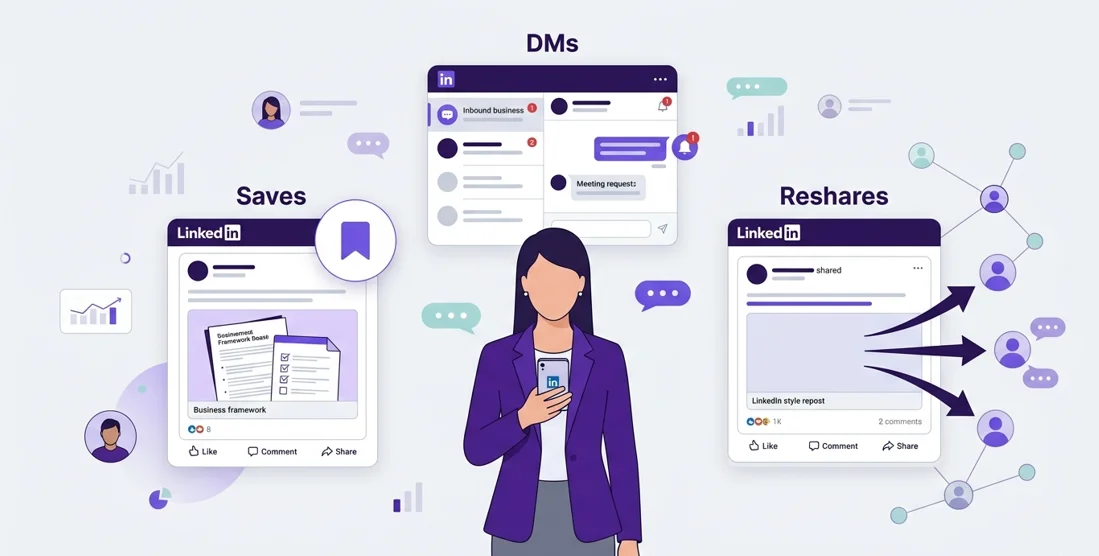
Saves, Reshares, and DMs: The High-Intent Signals Indian Founders Should Chase
Your marketing team presents the monthly LinkedIn report. Followers up 340. Impressions up 22%. One post crossed 8,000 views. Everyone in the room feels good for a moment, until someone asks a harder question: how many serious business conversations came from LinkedIn this month?
That is where most founder-led LinkedIn strategies collapse.
The signals Indian founders chased in 2023 are not the signals driving the pipeline in 2026. The founders winning on LinkedIn today are tracking a completely different set of numbers, and most marketing teams are still ignoring them.
The Vanity Trap: Why Follower Count Fooled Everyone
For years, Indian founders treated follower growth as proof that LinkedIn was working. More followers meant more visibility. More likes meant a stronger brand presence. The problem is, neither metric reliably translates into the pipeline.
One LinkedIn strategist summed it up perfectly: “Follower count is vanity, pipeline is sanity.” MagicPost’s research goes even further, stating that follower count has almost no correlation with whether content converts into business conversations or leads.
The algorithm shift in 2026 has made this gap even more obvious. LinkedIn now rewards depth of engagement over passive reactions. A save signals future relevance. A reshare signals trust. A DM signals intent. Likes barely register in comparison.
Here is what most founders still misunderstand:
- A post with 500 likes can generate zero qualified leads
- A post with 40 saves and 12 inbound DMs can generate ₹25 lakh in pipeline
- Viral reach creates visibility, not necessarily buyer intent
- Personal profiles still outperform company pages dramatically. Decode Growth reports founder-led posts receive up to 8× more reach than brand pages
- The algorithm increasingly prioritises content people return to, not content they casually react to
The result is a reporting problem inside many Indian companies. Marketing teams present reach metrics because they are easy to screenshot. Founders accept them because they look impressive. But neither tells you whether LinkedIn is influencing revenue.
That is the vanity trap. The numbers look bigger every month, while the pipeline stays flat.
Signal 1: Saves, The Clearest Sign of Practical Value
A LinkedIn save is not passive engagement. It is intentional.
When someone saves your post, they are telling the algorithm and themselves: “I will need this again.” That behaviour matters far more than a casual like. LinkedIn’s expanded saves and bookmarks tracking, rolled out more aggressively in late 2025, reflects this exact shift. The platform now treats saves as a high-value engagement signal because saved content tends to deliver long-term session activity and repeat visits.
MagicPost describes saves as one of the strongest indicators of “genuine value”. That definition matters for founders. People do not save motivational quotes. They save frameworks, checklists, operating insights, templates, numbers, and decision-making tools.
Think about the difference:
| Low-Save Content | High-Save Content |
|---|---|
| “Hard work always wins” | “7 mistakes Indian SaaS founders make while hiring SDRs” |
| Generic founder motivation | Pricing calculator walkthrough |
| Celebration post | Cash flow planning framework |
| Inspirational story | Vendor negotiation checklist |
A save is essentially a bookmark of trust.
If a CFO saves your post on reducing payment cycles, or an HR leader saves your hiring framework, your content has moved beyond awareness into utility. That is the first stage of commercial credibility.
This is also why save-heavy posts often generate delayed pipelines. The buyer may not engage publicly today. They return to the post two weeks later when the actual business problem appears internally.
Indian founders consistently underestimate this behaviour. B2B buyers on LinkedIn rarely announce intent in comments. They observe quietly, save selectively, and reach out later.
That makes saves one of the most important metrics to track weekly:
- High saves usually indicate strong problem-solution relevance
- A rising save-to-impression ratio often predicts future inbound interest
- Posts with strong saves tend to get extended algorithm distribution
- Save-heavy content compounds over time because users revisit and reshare it later
A founder posting operational insights about manufacturing margins, SaaS onboarding, logistics delays, or procurement mistakes will usually outperform generic “leadership” content on saves, even with lower reach.
That is the shift most Indian B2B founders still miss. LinkedIn is no longer rewarding content that people clap for. It is rewarding content that people return to.
Signal 2: Reshares, The Fastest Shortcut to Authority
A reshare is not engagement. It is an endorsement.
When someone reposts your content, they are attaching their reputation to your insight. That makes reshares one of the strongest trust signals on LinkedIn.
The algorithm rewards this behaviour aggressively. Posts with high repost activity often get a far wider secondary distribution than posts driven only by likes. More importantly, your content enters entirely new networks with built-in credibility.
That changes how people perceive you.
A founder may ignore your post in their feed. But if the same post is reshared by a respected industry peer, it instantly carries more authority.
This matters even more in Indian B2B markets, where trust and peer validation heavily influence buying decisions.
Content usually gets reshared for three reasons:
- It explains an industry shift clearly
- It gives people language worth repeating
- It makes the sharer look informed to their own audience
Reshares also create what most founders actually need: repeated exposure. Buyers rarely convert after seeing one post. They convert after seeing the same founder consistently recommended by people they already trust.
This is why reshares deserve weekly tracking:
- A spike in reposts often precedes inbound business conversations
- Reshared posts tend to attract higher-quality profile visits
- Secondary audiences usually include more senior decision-makers
- Reshares compound reach without paid distribution
Most Indian founders are still optimising for applause. The smarter ones are optimising for advocacy.
Because when someone reshares your post, they are effectively saying: “You should listen to this person.”
Signal 3: Inbound DMs, the Closest Thing to Buying Intent
Nothing beats an inbound LinkedIn DM from a prospect.
A like is passive. A save shows interest. A DM signals intent.
The moment someone messages you about a post, they have moved from scrolling to considering action. They have read your thinking, checked your profile, and decided you are worth speaking to. That is why inbound DMs are the highest-intent signal on LinkedIn.
MagicPost calls DMs “the most direct signal that your content is working”, and the data backs it up. Several B2B LinkedIn benchmarks show that consistent founder-led posting typically generates 3 to 8 inbound conversations per month from target accounts alone.
More importantly, these are not cold leads.
A founder, procurement head, or marketing director reaching out after seeing your content already enters the conversation with context and familiarity. The trust-building has partially happened before the sales call even begins.
Track these manually every week:
- Who messaged you
- Which post triggered the DM
- Whether the message came from a target account
- Whether it moved into a meeting or sales conversation
Even small numbers matter here.
Four relevant DMs a month with a 25% conversion rate means one serious sales conversation. For most Indian B2B companies, that creates more business value than gaining 1,000 new followers from low-intent viral content.
What Each Signal Actually Predicts
Most founders track LinkedIn metrics in isolation. The smarter approach is to connect each signal to a stage in the buying journey. Saves, reshares, and DMs each indicate a different level of trust and commercial intent.
| Signal | What it Actually Means | Pipeline Implication |
|---|---|---|
| Saves | Your content was useful enough to revisit | Strong top-of-funnel interest. Saved posts are often revisited during internal discussions and vendor evaluation. |
| Reshares | Someone publicly endorsed your thinking | Expands reach and accelerates trust-building with new audiences through peer validation. |
| Inbound DMs | A prospect wants direct interaction | High-intent buying signal. These conversations often convert into discovery calls, referrals, or active opportunities. |
This framing changes how LinkedIn performance should be reported internally.
Over time, founders should start calibrating these signals against actual business outcomes. A save may predict future interest. A reshare may predict authority growth. A DM usually predicts revenue opportunities.
A Weekly Tracking System Founders Will Actually Maintain
Most LinkedIn reporting systems fail because they are too complicated. Founders do not need a 14-tab dashboard. They need a 10-minute weekly review that connects content activity to commercial signals.
The framework below is simple enough to maintain consistently and specific enough to reveal patterns that actually matter.
Run this review every Friday. Most LinkedIn posts accumulate the majority of their engagement within 48 to 72 hours, which makes end-of-week tracking far more reliable than daily monitoring.
| Metric | Week 1 | Week 2 | Week 3 | Week 4 |
|---|---|---|---|---|
| Total saves | ||||
| Average saves per post | ||||
| Reshares with commentary | ||||
| Plain reposts | ||||
| Inbound DMs from content | ||||
| DMs from ICP profiles | ||||
| Profile views after posting | ||||
| Top-saving post topic |
The last row matters more than most founders realise.
If the same topic repeatedly appears under “Top-saving post topic”, that is your market telling you what it wants more of. That topic should shape next month’s content strategy.
The DM column matters even more.
If total saves are rising but ICP DMs remain flat, your content is attracting attention without attracting the right buyers. That usually means the topic is too broad, too motivational, or too disconnected from commercial pain points.
One more addition makes this system significantly more valuable: track which specific post triggered each discovery call.
After six months, you will know exactly which content themes create actual sales conversations. That insight is infinitely more useful than a monthly follower growth screenshot.
How to Report These Signals to the Board
Most boards do not care about likes, impressions, or “engagement”. They care about pipeline, meetings, and revenue potential.
That means founders need to present LinkedIn metrics as commercial indicators, not marketing activity.
Instead of saying:
- “Engagement increased 18%.”
Say:
- “Inbound DMs from target accounts increased from 2 to 7 this month”
- “Two discovery calls came directly from LinkedIn content”
- “Posts reshared by industry leaders expanded reach into new enterprise accounts”
- “Saved posts are consistently generating follow-up conversations”
The language matters.
Treat saves, reshares, and DMs like early-stage lead signals:
| Signal | How to Report It |
|---|---|
| Saves | “This post earned 22 saves from finance leaders. That indicates strong buyer interest around this topic.” |
| Reshares | “Three industry operators reshared the post, expanding visibility within our target market.” |
| Inbound DMs | “We received 5 qualified inbound messages, resulting in 2 sales conversations.” |
One more important shift: connect content activity to CRM outcomes wherever possible.
If LinkedIn-driven conversations now influence 15% to 20% of pipeline opportunities, report that directly. That changes LinkedIn from a “branding channel” into a measurable demand engine.
Boards understand pipeline language. Use it.
Next Steps: What to do Tomorrow
The goal is simple: stop treating LinkedIn like a visibility channel and start treating it like a trust-building system tied to a pipeline.
- Track Your Data: Export your LinkedIn post analytics today. Record last week’s saves, reshares, and inbound DMs in a spreadsheet using the tracking structure above. This becomes your baseline.
- Optimise Your Content: Plan one post for tomorrow. Make it genuinely useful, so people save it. Make it opinionated, specific, or unexpected so people reshare it. End with a clear question or prompt that encourages replies and DMs.
- Follow Up on Signals: Review who saved your posts or messaged you recently. Start conversations directly.
A simple message works: “Notice you engaged with my post on pricing strategy. Happy to share a few more observations if useful.” - Include These Metrics in Reporting: In your next team or board update, report saves, reshares, and inbound DMs alongside pipeline conversations.
For example, this week we recorded 4 saves, 2 reposts, and 1 inbound inquiry from a target account.
By tomorrow morning, you will have something most founders still lack: a LinkedIn system tied to commercial intent, not vanity metrics. Keep chasing trust and buyer interest, not applause.
Key Takeaways
- GEO gets your content cited in AI answers
- AI citation beats traditional ranking for B2B pipeline
- Four factors drive LLM visibility: structure, authority, entities, format
- B2B buyers arrive pre-qualified from AI research
- Start with a query audit and three restructured pages
FAQs
1. Why are saves more important than likes on LinkedIn in 2026?
A save indicates future relevance. It shows the reader found the content useful enough to revisit later. LinkedIn’s algorithm now treats saves as a stronger quality signal than passive reactions because saved content drives repeat engagement.
2. What type of LinkedIn posts generate the most saves?
Posts with practical utility perform best. Frameworks, operational lessons, hiring insights, financial breakdowns, checklists, and industry-specific observations consistently outperform generic motivational content.
3. How many inbound DMs should founders expect from LinkedIn content?
Consistent founder-led posting typically generates 3 to 8 inbound conversations per month from relevant audiences. The exact number matters less than the quality of the conversations and whether they convert into meetings or pipeline opportunities.
4. Why do reshares matter more than reach?
A reshare carries implied trust. When someone reposts your content, they are effectively recommending your thinking to their network. That peer validation accelerates credibility faster than standalone impressions.
5. What is the simplest way to track LinkedIn performance?
Track only five things weekly: saves, reshares, inbound DMs, DMs from ICP accounts, and top-performing content topics. A simple spreadsheet reviewed every Friday is usually enough to identify patterns that influence the pipeline.
Sources:
- https://magicpost.in/blog/how-to-measure-content-performance#:\~:text=engagement%20type
- https://decodegrowth.in/blogs/linkedin-personal-branding-indian-founders/#:\~:text=A%20post%20from%20your%20personal,more%20shares%20than%20corporate%20content
- https://formanorden.com/blog/linkedin-gtm-strategy-b2b-saas/#:\~:text=Profile%20view%20rate%20LinkedIn%20,to%206%20to%208
- https://www.linkedin.com/posts/oscarhoole_my-last-30-posts-generated-247-inbound-dms-activity-7449803978495668224-VWcp#:\~:text=My%20last%2030%20posts%20generated,Let%27s%20call
Need expert content support? LexiConn has been India's B2B content partner since 2009, building content systems for leading enterprise brands across BFSI, technology, and media. Explore our thought leadership services →