
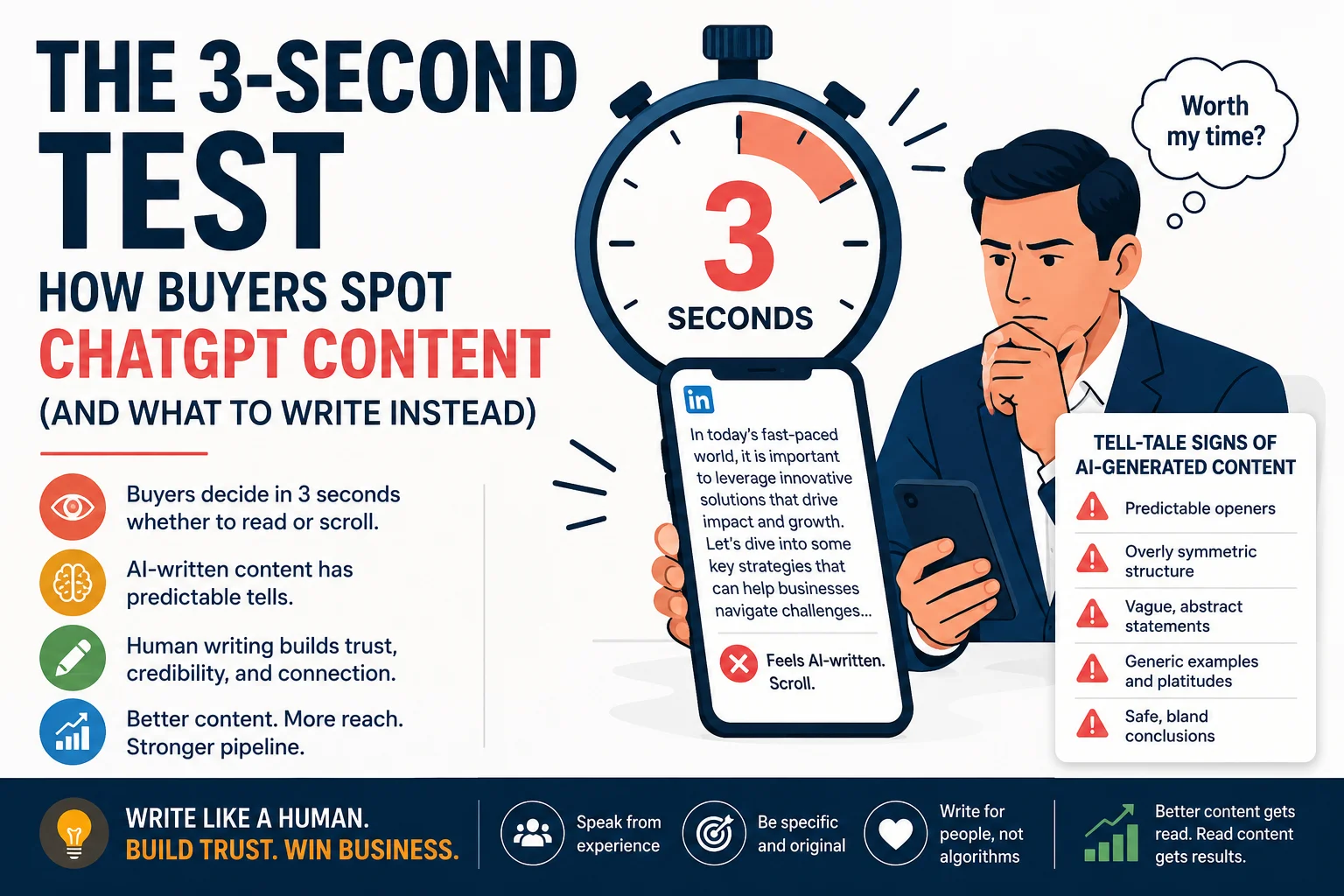
The 3-Second Test: How Buyers Spot ChatGPT Content (and What to Write Instead)
Your buyer opens LinkedIn during a 10-minute break between calls. They scroll. A post catches their eye, or it doesn't. That decision happens in under 3 seconds. Not because they're lazy. Because they've been trained by thousands of posts to pattern-match instantly: real person or bot?
If the answer feels like the latter, they're gone. No second chance.
Knowing how to spot AI-generated content on LinkedIn isn't just a reader skill anymore. It's survival knowledge for every founder who publishes on the platform. Because if your buyers can do it, and they can, your content strategy has a fundamental problem.
What "3 Seconds" Actually Means in LinkedIn Feed Behavior
LinkedIn's feed is not read. It's scanned.
Eye-tracking studies on social feeds show that users spend an average of 1.7 seconds on a post before deciding to stop or scroll. For text-heavy content, that window is slightly longer, but the judgment is still made before the third sentence.
What are they scanning for? Not information. Signal.
Readers are asking: Does this sound like someone I'd want to learn from? Does this feel like a real take, or recycled advice dressed up in clean formatting?
A 2024 study by the Reuters Institute found that 63% of online readers can identify AI-generated text within the first paragraph, not because they run it through a detector, but because the texture of the writing feels off. Flat. Symmetrical. Strangely complete.
That texture is what we're dissecting here.
Tell 1: The Predictable Opener
There are roughly six ways ChatGPT starts a LinkedIn post, and most founders have used at least three of them this month.
The Declaration: "The future of [industry] is here." The Confession: "I used to think X. I was wrong." The Observation: "Something interesting happened to me last week." The Question: "What separates good founders from great ones?" The Stat Drop: "73% of B2B buyers say..." The Listicle Tease: "5 things I wish I knew before..."
None of these openers are inherently bad. The problem is that when AI writes them, they arrive without the specific detail that makes them believable. There's no friction, no particularity, no moment that could only have come from one person's actual life.
Compare these two openers:
AI-written: "I used to think cold outreach was a numbers game. I was wrong. Here's what I learned."
Human-written: "We sent 1,400 cold emails in Q1. 11 replies. 2 calls. 0 deals. The founder who eventually bought from us found us through a LinkedIn post I wrote at 11pm after a frustrating board meeting."
The second opener is inconvenient. It's specific. It has an embarrassing number in it. AI doesn't volunteer embarrassing numbers, it optimizes for credibility. Real founders earn credibility by showing the mess.
Tell 2: Structural Symmetry
This one is harder to articulate but immediately obvious once you've seen it.
AI-generated content has a quiet obsession with balance. Three points in every section. Parallel sentence lengths. Subheadings that rhyme in structure if not in words. A rhythm that never breaks.
Human writing is syncopated. It has one-line paragraphs that land hard. It has asides. It has sentences that run a little long because the thought needed room. And then it stops.
Here's the pattern AI almost always follows for a "framework" post:
| AI Structure | Human Structure |
|---|---|
| Intro (3 sentences) | Intro (1, 7 sentences, varies by energy) |
| Point 1 with example | First thing that actually happened |
| Point 2 with example | Tangent that turns out to matter |
| Point 3 with example | The one thing, stated plainly |
| Conclusion (3 sentences) | One line. Done. |
Indian B2B founders posting consistently on LinkedIn, think operators in manufacturing, SaaS, logistics, or professional services, tend to break this pattern naturally when they write from experience. The asymmetry is a feature, not a bug.
When you read a post from someone like Karan Bajaj (founder of WhiteHat Jr, now building Monk Entertainment) or Harsh Jain (founder, Dream11), the rhythm is unpredictable. Ideas arrive in chunks, not columns. That's not an accident. That's the texture of a person thinking on the page.
Tell 3: Vague Verbs and Abstract Claims
This is the most damaging tell, because it's the one that quietly kills trust.
AI content is full of doing words that don't describe any actual action:
- "We leveraged our network..."
- "The team executed flawlessly..."
- "We focused on delivering value..."
- "I doubled down on what mattered..."
What does "leveraged" mean? What did the team actually do? What value, specifically, was delivered?
These phrases are cognitive placeholders. They signal activity without transmitting information. Buyers reading your content are trying to assess whether you understand their world. Vague verbs tell them you probably don't.
The fix is almost always a single concrete noun or number:
| Weak (AI-typical) | Strong (human-specific) |
|---|---|
| "We leveraged partnerships" | "Our CA firm introduced us to 3 CFOs in Pune" |
| "We focused on retention" | "We called every churned customer in January. 6 of 14 came back." |
| "I doubled down on content" | "I posted every Tuesday for 11 weeks. Week 9 was the first one that got traction." |
| "We delivered value quickly" | "First deliverable in 48 hours. Client shared it internally before we invoiced." |
Specificity is the currency of trust on LinkedIn. AI doesn't know your specifics. You do. That's your moat.
Tell 4: The Closing Platitude
Read a hundred AI-generated LinkedIn posts and you'll find the same ending, dressed in slightly different words:
"The lesson? [restatement of what was already said]. What do you think? Drop a comment below."
Or: "Success comes to those who [vague motivational phrase]. Remember that."
Or worst of all: "At the end of the day, it all comes down to [thing everyone already knows]."
The closing platitude is AI's way of signaling completion. It wraps things up. It ties a bow. It asks for engagement in the most transactional way possible.
Human posts end differently. Sometimes they end mid-thought. Sometimes they end with a question that's genuinely uncomfortable. Sometimes they end with something the writer isn't sure about yet.
The most-engaged posts on LinkedIn in 2025 ended without asking for anything. The writer said what they had to say and stopped. The comments came anyway, because the post created a thought worth responding to, not a prompt asking for a response.
Why the Algorithm Penalizes AI-Like Content (And It Will Get Worse)
LinkedIn's algorithm doesn't detect AI writing. It detects engagement velocity and dwell time.
Here's what this means in practice: when a reader scans your post in 1.5 seconds and scrolls, that's a signal. When they read for 12 seconds, pause, and come back, that's a very different signal. The algorithm is measuring attention, and AI-generated content, despite its polish, consistently fails to hold it.
A 2025 analysis by Richard van der Blom (one of LinkedIn's most-cited algorithm researchers) found that posts with high "scroll-stop rate", meaning the reader pauses after seeing the first line, had 3, 4x better reach than posts with similar engagement counts but lower dwell time.
AI openers don't stop scrolls. They confirm expectations. A reader sees "I used to think X. I was wrong." and their brain already knows what's coming. No reason to stop.
Worse: LinkedIn has been quietly testing content quality signals since late 2024. Accounts with consistent low-dwell, low-comment content see reach throttled over time, even if individual posts get reasonable likes. The platform is optimizing for conversation, not consumption.
For Indian founders posting from accounts with smaller networks, this matters even more. You're not starting from 50,000 followers. Every post has to earn its reach. Generic content is not just ineffective, it's actively punished.
The Injection Method: How to Write Like a Human
The goal is not to hide AI, it's to use it differently.
Most founders use AI as a ghostwriter. They type a topic, get a post, publish it. The output is grammatically correct and entirely devoid of them.
The better workflow is to use AI as an editor, not an author.
Here's the Injection Method:
Step 1: Write the raw material yourself. Voice memos work well. Bullet points work. Even a WhatsApp message to yourself describing what happened. The goal is unfiltered observation, the specific thing that occurred, the number that surprised you, the moment you changed your mind.
Step 2: Inject the raw material into AI with a tight brief. "Here are my rough notes on what happened last week with a client. Help me structure this into a LinkedIn post. Do not add any claims, examples, or insights that aren't in my notes. Keep my language where possible."
Step 3: Review for the four tells. Check the opener (is it specific?), the structure (does it breathe?), the verbs (are they concrete?), and the close (does it end with something real?).
Step 4: Rewrite the first line and the last line yourself. These are the two highest-leverage points in any post. They define how it starts and what it leaves behind. If AI wrote both, the post isn't yours.
This workflow takes 20, 30 minutes per post. It produces content that passes the 3-second test because it's anchored in something only you could have written.
If you're building a consistent LinkedIn presence as a founder and want this to work as a system rather than a weekly scramble, the kind of structured LinkedIn personal branding support that starts with your raw material, not a template, tends to compound far faster than content produced from scratch by an external team.
A Pre-Publish Checklist Founders Can Follow Today
Before you hit publish, run this in under 5 minutes:
The 3-second test is: reading only the first two lines of your post aloud and asking honestly, does this sound like something a real person in my position would say, or does it sound like a LinkedIn post?
If the first two lines could have been written by anyone, they'll be read by no one.
Quick checklist:
-
First line check, Does it contain a specific number, name, date, or moment? If not, rewrite it.
-
Verb audit, Scan for "leveraged," "focused," "executed," "delivered value," "doubled down." Replace each with what actually happened.
-
Symmetry test, Read the post and notice if every section is roughly the same length. If yes, collapse one section or expand one with a specific detail.
-
Closing check, Does your last line ask for a comment, restate the title, or offer a motivational quote? Cut it. End one line earlier.
-
The stranger test, Would someone who doesn't know your company understand what you actually do, and why you specifically are worth listening to? If not, add one line of context.
These five checks take less time than the average founder spends choosing a hashtag. And they will do more for your reach than any posting schedule or growth hack.
What to Do Next
Don't audit your last 10 posts. That's demoralizing and not the point.
Instead, pick your next post, the one you'd normally write in 20 minutes using a prompt, and try the Injection Method once. Write the raw material first. Even three bullet points from something real that happened this week. Then bring in the tool.
See if the output feels different. See if you'd stop for it.
If you want to build this into a repeatable system, one that doesn't depend on your energy levels or whether you remembered to post this Tuesday, that's a content strategy conversation worth having. Not because you need more content, but because you need content that actually works for your specific context, audience, and goals.
LexiConn runs a free content pilot for founders who want to test this approach before committing to anything. One post, built the right way, so you can see what different actually looks like.
The buyers scrolling your feed are making decisions about you in 3 seconds. Make those seconds count.
Need expert content support? LexiConn has been India's B2B content partner since 2009, building content systems for leading enterprise brands across BFSI, technology, and media. Explore our content strategy services →