
The AI Slop Epidemic on LinkedIn: How to Write Like a Human Again
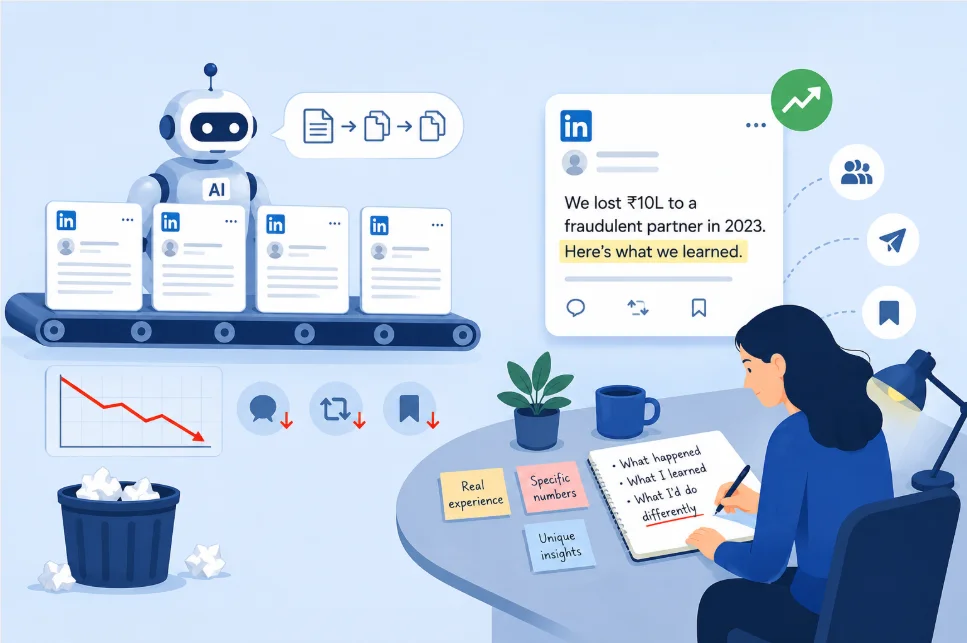
Merriam-Webster’s 2025 Word of the Year was “slop”: low-quality digital content mass-produced by artificial intelligence. No professional platform has been hit harder than LinkedIn. Originality.ai’s analysis of 8,795 long-form LinkedIn posts found that 54% of posts over 100 words were likely AI-generated by late 2024, up sharply from near-zero levels before 2023.
Indian founders are now seeing the consequences in real time. Reach is falling, comments feel hollow, and buyers are scrolling past posts that all sound the same. This is not random platform fatigue. LinkedIn’s 360 Brew algorithm increasingly rewards content that creates genuine engagement signals, especially saves, shares, DMs, and meaningful dwell time. AI-written filler struggles on all four.
The solution is not to stop using AI. It is to stop treating AI like a ghostwriter and start treating it like a scaffold. That distinction now matters more than any prompt formula or posting hack.
What “AI Slop” Actually Means on LinkedIn
AI slop is not the same as AI-assisted content. The distinction is editorial control.
AI slop is content generated by a language model with too little human friction:
- No lived experience added
- No specific data inserted
- No genuine opinion staked
- No editing pass that makes the post sound like a real person instead of a statistically average professional
The irony is that slop often looks polished. The grammar is clean. The structure is clear. The topic is covered. The problem is how it gets covered.
A language model writes the way a language model has been trained to write, by averaging across millions of posts it has already seen and predicting the most probable next sentence. That is not thinking. It is pattern matching.
The result is content with a very specific hollowness. As one analyst describes it, AI writing tools produce posts that are “calm, balanced, and remarkably earnest” regardless of topic, because the models are optimised to generate something safe, readable, and broadly agreeable.
That calibration is the problem.
“Safe” and “broadly agreeable” are terrible traits for a founder trying to build a distinct point of view in a competitive category.
Indian LinkedIn feeds in 2026 now have a recognisable flavour of slop:
- A generic opener about the founder’s industry: “The manufacturing sector is evolving rapidly”
- Three or four numbered insights any consultant could have written
- A closing line about resilience, leadership, or the future of work
- Zero information that only this founder, from this company, in this market, could know
That last part is the tell.
Slop is content written by nobody in particular, for everybody in general.
The 3-Second Test: How Buyers Spot It
LinkedIn audiences have no patience for bland intros. Research shows the average user decides in roughly 2.5 seconds whether a post deserves attention. A recent LinkedIn analysis makes the point even more bluntly: if the opening does not create immediate relevance or curiosity, “the rest might never even register.”
In practice, the first line has one job: answer “Why should I care?” before the thumb scrolls away.
Picture a busy CTO or procurement head moving through their feed between meetings. If the post opens with recycled corporate language or generic thought leadership, attention disappears instantly. Buyers now recognise AI slop on sight:
- Empty adjectives
- Predictable frameworks
- Generic motivation
- Buzzwords pretending to be insight
The reaction is immediate: “seen this before.”
That is the real 3-second test.
Every word in the opening line has to earn attention. A vague statement or overused phrase like “cutting-edge innovation” or “creating synergy” fails immediately. Strong LinkedIn writing now works more like a cold open in film or stand-up comedy. It gets specific fast. It creates tension fast. It signals relevance fast.
If the first line does not feel useful, surprising, or painfully relevant, the buyer keeps scrolling.
The Four Tells That Are Destroying Indian Founder Credibility
There are dozens of patterns that signal AI-generated writing. But four are doing the most damage on Indian LinkedIn because they are everywhere, and because they sound nothing like how actual operators speak.
Tell 1: The Opener That Could Be About Anything
The AI-generated opener is designed to sound relevant while saying almost nothing specific.
- “The business landscape is shifting.”
- “Leadership is more important than ever.”
- “Digital transformation is no longer optional.”
These lines appear constantly because they are statistically common on LinkedIn. The model produces them because similar phrases appeared near similar topics in its training data.
They are not false. They are just useless.
A founder who has spent six months fighting for shelf space in a Tier 2 market, managing a customs delay that cost INR 40 lakh, or rebuilding a sales team mid-quarter has access to information that is precise, messy, and real.
The AI does not.
It produces the average. The average is boring.
Tell 2: The Vague Reference to Research
AI-generated LinkedIn posts love non-specific authority signals:
- “Studies show that…”
- “Research indicates…”
- “Experts agree…”
These phrases function as placeholders.
The model learned that academic-sounding hedges often appear next to business claims, so it reproduces the pattern whether or not real evidence exists behind it.
Experienced B2B buyers spot this immediately.
There is no study name. No source. No expert identity. No actual citation. The post signals credibility without providing any. That is often the giveaway that the content was generated first and justified later.
Tell 3: The Rule of Three That Explains Nothing
Large language models have a strong statistical preference for list structures, especially the rule of three.
Ask an LLM for insights on leadership, hiring, pricing, or growth, and it will usually produce:
- Three points
- Sometimes five
- Rarely one or two
The structure itself is not the issue. The issue is abstraction.
Point 1 says something generic. Point 2 says something equally generic. Point 3 wraps everything together with a soft call to “embrace”, “recognise”, or “commit to” the lesson.
Nothing in the list tells the reader what to actually do tomorrow morning.
That is the structural signature of slop. It resembles an argument without containing one.
Tell 4: The Frictionless Perspective
This is probably the most damaging tell of all.
AI models are trained to produce content that feels safe, balanced, and broadly agreeable. As a result, AI-generated posts almost never take a real position.
They:
- Acknowledge every perspective
- Balance every tradeoff
- Avoid strong disagreement
- Arrive at conclusions that almost everyone would accept
But founders who have spent ten years building companies do not think like that.
They believe some accepted industry practices are wrong. They have made unpopular decisions. They hold opinions that their peers disagree with. They have seen outcomes that contradict conventional wisdom.
That tension is where interesting thought leadership comes from.
An unedited AI draft removes most of it, because the model has been trained to smooth conflict away.
Why the 360 Brew Algorithm Now Actively Penalises It
The algorithmic case against slop is now as strong as the audience case.
LinkedIn’s 360 Brew, the 150-billion-parameter AI model that replaced the platform’s ranking system in late 2024, evaluates content semantically. It is no longer relying primarily on crude engagement triggers or keyword matching.
According to platform analysis by Falia, the system now evaluates:
- Whether the content demonstrates genuine expertise
- Whether the creator has topical authority based on profile and posting history
- Whether the writing reflects original thinking or statistically predictable output
That shift matters because AI slop performs badly on all three.
Originality.ai’s analysis of nearly 9,000 long-form LinkedIn posts found that likely AI-generated posts received 45% less engagement than likely human-written posts.
Autoposting.ai’s breakdown of the 2025 algorithm changes puts the penalty even more sharply:
- 30% less reach
- 55% less engagement
Once LinkedIn’s systems identify a post as generic AI content, distribution collapses.
That is not underperformance. It is algorithmic irrelevance.
What makes this more interesting is that 360 Brew does not necessarily need explicit AI detection to suppress slop. The same behavioural patterns that make a post feel empty to a human reader also create negative ranking signals for the algorithm.
Low-quality AI content typically produces:
- Low dwell time
- Few saves
- Weak comment depth
- Fast scrolling behaviour
- Minimal profile clicks or DMs
Those signals collectively tell the system the post lacks informational value.
In that sense, slop suppresses itself. Audience behaviour creates the algorithmic penalty even before AI fingerprinting enters the equation.
PostEverywhere’s analysis of the 2026 LinkedIn update confirms the same pattern. AI-sounding content is increasingly treated as spam-adjacent behaviour, especially when it relies on repetitive structures, generic phrasing, and predictable formatting.
The platform’s August 2025 LLM integration made LinkedIn significantly better at understanding:
- Context
- Topical depth
- Creator expertise
- Semantic originality
Those same capabilities also make it much better at identifying content that lacks all four.
The Founder’s Mandate: Friction, Specificity, Contrarian POV
The antidote to AI slop is friction.
Founders need to write with texture, not smoothness. That means adding the kind of detail an LLM cannot invent:
- Specific numbers
- Messy decisions
- Real tradeoffs
- Uncomfortable lessons
- Opinions with consequences
Startup founder Shobhit Goyal went viral not because he shared “entrepreneurial struggles,” but because he named the actual damage:
- A ₹10 lakh payment lost
- A fraudulent business partner
- Specific operational failures
That level of detail instantly feels human because it comes from lived experience, not pattern generation.
Similarly, entrepreneur Suhail Khan broke down his journey in concrete milestones: “Failed startup -> 100K readers -> 6-figure side hustle.” Dates, progression, and measurable outcomes made the story believable.
These are details AI rarely generates naturally because they require memory, stakes, and personal context.
Friction also means having a point of view.
Agreeable content disappears into the feed. Contrarian content creates attention and discussion. Personal branding strategist Sakshi Darpan puts it directly: “Share your unpopular opinions. The fastest way to stand out isn’t to blend in. Take a stance. Challenge industry clichés.”
For founders, that could sound like:
- “Micromanaging early employees actually helped us survive our first year.”
- “Most B2B founders are hiring sales teams too early.”
- “We stopped chasing enterprise clients, and revenue improved.”
The point is not manufactured controversy. The point is an identifiable judgment.
Real operators have opinions shaped by experience, mistakes, and consequences. AI-generated content tends to flatten those edges because the model is optimised to sound balanced and safe.
Be specific wherever possible.
Ask:
- What exact number can I include?
- What exact date matters here?
- Which customer interaction changed my thinking?
- What operational detail would only someone inside this business know?
If you taught students, mention the strange question one of them asked in 2022. If you lost a deal, mention the reason. If you closed a contract, mention the size, timeline, or challenge involved, even if anonymous.
These anchors of reality do two things at once:
- They make the writing feel unmistakably human
- They signal actual expertise to both readers and the algorithm
In 2026, personal branding is no longer about sounding polished. It is about sounding real enough that buyers trust there is an actual operator behind the profile, which is exactly why more founders are turning to LexiConn’s LinkedIn personal branding services built specifically for senior leaders and SME founders.
A Simple AI Workflow That Does Not Produce Slop
This workflow has six steps. The key distinction at every stage is simple: what AI does versus what the founder must still do personally. The founder’s inputs cannot be outsourced.
| Step | What AI Does | What You Add |
|---|---|---|
| Brief | Nothing yet | You write the topic, one specific example, your actual opinion, and one real number |
| Structure | Generates a logical H2 outline from your brief | Accept, reject, or reorder sections based on your argument |
| First Draft | Writes rough paragraphs using your inputs as anchors | Review every paragraph and ask: “Would I actually say this?” |
| Friction Pass | Nothing | Add one uncomfortable fact, one specific rupee figure, and one thing you would normally hesitate to admit publicly |
| Voice Edit | Nothing | Rewrite the opening sentence of every section in your own words. Delete hedge language and generic filler |
| Publish Check | Runs the 7-question checklist | If any answer fails, revise before posting |
The most important stage is Step 4: the friction pass.
This is the step that separates AI-assisted writing from AI slop.
The friction pass forces the founder or content lead to introduce something with narrative risk:
- A specific failure
- A number that does not flatter the company
- An opinion that contradicts standard industry advice
- A messy operational reality
Without that layer, the AI structure gets published with the AI voice still intact. The result feels generic even when the underlying idea originally came from the founder.
The good news is that this workflow does not need to consume an entire day. A strong LinkedIn post can move through all six stages in under 45 minutes.
Ironically, the longest step is usually Step 1.
Writing a genuinely specific brief forces the founder to articulate what they actually believe before handing the task to AI. That act of articulation is where most of the thinking happens, and that thinking is exactly what makes the final post sound human.
The Pre-Publish Checklist: 7 Questions
Before hitting “Post,” run the draft through this checklist. If the answer to any question is “no,” revise the post before publishing.
Before hitting “Post,” run your draft through these seven checks. If any answer is “no,” revise it.
- Hook Test: Does the opening sound specific and human, not like generic AI filler?
- Concrete Detail Check: Is there at least one real number, example, or lived detail?
- Voice Consistency: Does the post sound like you are speaking naturally?
- Eliminate Crutches: Remove clichés, buzzwords, and templated phrases like “in conclusion.”
- Stance Check: Does the post take a clear position instead of sitting safely in the middle?
- Authenticity Scan: Does it feel human, or overly polished and sterile?
- CTA Check: Is the ending a genuine question or action, not engagement bait?
These questions may seem picky, but they force you to remove the most obvious AI signals before the post goes live.
Once a draft passes this checklist, it usually sounds more human, more opinionated, and more credible. Those are exactly the qualities that make people pause, save, share, or message the founder directly.
At the end of the day, LinkedIn’s 2026 feed rewards substance over polish. The platform is increasingly prioritising relevance, depth, specificity, and genuine conversation over perfectly formatted generic content.
What to Do Tomorrow Morning
Open the last LinkedIn post you published using AI. Run the seven questions against it. Count how many it fails.
If it fails three or more times, you now know why your reach collapsed on that post. The AI produced the structure, you approved the structure, and the post went out with no lived experience, no specific number, and no position that anyone could push back on.
The fix is not a better prompt. The fix is writing a brief before you prompt. That brief must contain: one specific thing that happened in your business in the last 90 days, one number with context, and one thing you believe that your industry would partially disagree with. Give the AI that brief. Then the friction passes by itself.
Your B2B buyers are not asking you to write without AI. They are asking you to write like yourself. In 2026, those are not the same instructions.
Key Takeaways
- LinkedIn’s 360 Brew algorithm actively suppresses generic AI-generated content
- AI slop is defined by missing friction, specificity, and a real founder perspective
- B2B buyers can detect templated LinkedIn writing in under three seconds
- The best founder posts use AI for structure, but keep judgment, stories, and opinions human
FAQs
1. What exactly counts as “AI slop” on LinkedIn?
AI slop is content generated with little or no human editorial input. It usually lacks lived experience, real numbers, strong opinions, or operational detail. The result is polished writing that feels generic and interchangeable.
2. Is LinkedIn actually penalising AI-generated content?
Yes. Multiple platform analysts report that LinkedIn’s 360 Brew algorithm now downranks content that feels repetitive, generic, or semantically shallow. Posts with low dwell time, weak comments, and few saves lose distribution quickly.
3. Should founders stop using AI for LinkedIn posts?
No. The problem is not AI usage, but AI dependency. The strongest LinkedIn posts use AI for ideation, structure, and editing while keeping the founder’s voice, experience, and judgment at the centre.
4. What makes a LinkedIn post feel human in 2026?
Specificity. Real numbers, uncomfortable lessons, operational details, and clear opinions are what separate authentic thought leadership from AI-generated filler. Buyers trust posts that sound lived, not manufactured.
5. What is the fastest way to improve LinkedIn content quality?
Start every post with a proper brief before prompting AI. Include one recent business event, one real metric, and one opinion your industry may disagree with. That single change dramatically improves originality and engagement.
Sources:
- https://www.merriam-webster.com/wordplay/word-of-the-year
- https://originality.ai/blog/ai-content-published-linkedin
- https://www.hengarth.com/post/linkedin-s-ai-slop-problem
- https://medium.com/@careertips101/unlocking-linkedins-360brew-the-ai-powering-smarter-recommendations-406cec604038
- https://originality.ai/blog/ai-content-published-linkedin
- https://autoposting.ai/linkedin-algorithm/
- https://www.linkedin.com/posts/shobhitgoyal07_startup-entrepreneurship-failure-activity-7204791294815064065-zRCE#:\~:text=While%20everyone%20is%20talking%20about,decisions%20of%20my%20life%20which
- https://www.linkedin.com/posts/iam-suhail_failed-startup-100k-readers-6-figure-activity-7366647322048409600-QbZZ#:\~:text=Failed%20startup%20%E2%86%92%20100K%20readers,link%20in%20the%20first%20comment
Need expert content support? LexiConn has been India's B2B content partner since 2009, building content systems for leading enterprise brands across BFSI, technology, and media. Explore our thought leadership services →