
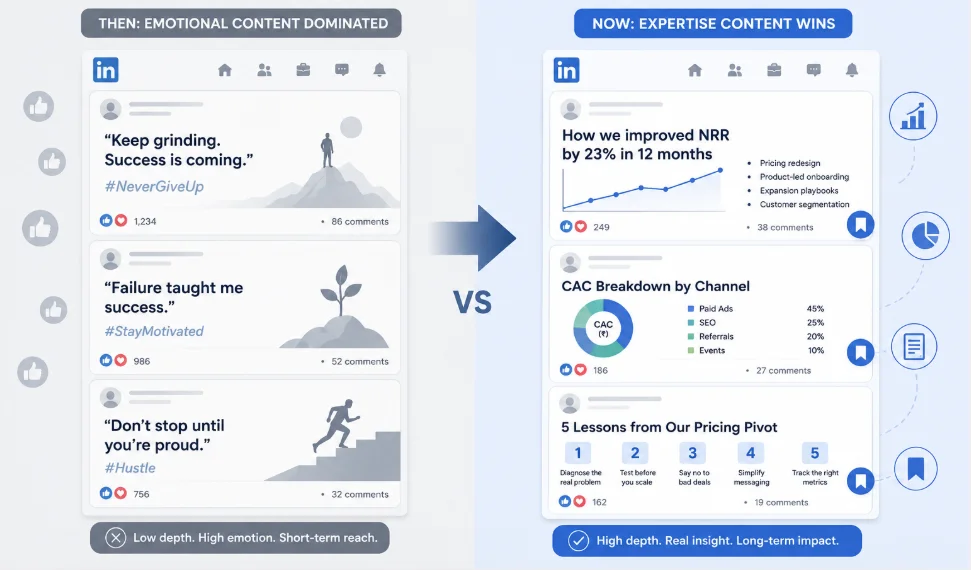
Why Your Motivational LinkedIn Posts are Dying in 2026 (and What to Write Instead)
LinkedIn’s old playbook of feel-good anecdotes, hustle quotes, and “broetry” posts no longer works. What once built fast reach is now being deprioritised after the 2026 “360 Brew” update, with early platform analysis showing a 40, 65% drop in organic reach for low-effort motivational content.
The shift is not subtle. The algorithm now rewards depth, specificity, and real insight, while audiences openly reject generic inspiration. As one user bluntly put it, “When I see motivational posts, I just think of how fake they are.” The result is clear: the content that once built founder visibility is now the fastest way to lose it.
The Genre That Built LinkedIn and Why It Is Dying
“Broetry” built LinkedIn’s early growth. These were short, emotional vignettes presented as life advice, often concluding with a simple moral. At the time, they were effective because the platform was less crowded, and emotional storytelling could easily break through. But what once felt fresh now reads like repetition. As one LinkedIn expert notes, founders often “got away with posting obvious takes, recycling generic advice… writing for everyone and no one.”
This format thrived in a quieter feed. Today, it signals low intent and low value. Even user sentiment has turned sharply, with Reddit discussions often mocking LinkedIn as a “look how primed I am for success” circlejerk. The pattern is clear. What used to feel inspirational now feels predictable.
The breakdown of broetry is not random. It reflects a deeper shift in how content is evaluated:
- Then: Emotional storytelling -> high reach
- Now: Generic emotion without insight -> low distribution
- Then: Personal journey \= authority
- Now: Personal journey without substance \= noise
As Sagar D. points out, many founders still treat LinkedIn like a press release or a viral lottery. But content is no longer about announcements or inspiration loops. It is about opinion density. Or as one line captures the shift clearly, “the feed doesn’t reward noise. It rewards clarity.”
This is why classic motivational posts now fail. Not because storytelling is dead, but because empty storytelling has become invisible.
What Audiences Are Openly Mocking
The backlash is not just algorithmic. It is cultural.
Search any professional community, and the reaction pattern is consistent. Posts that follow the broetry formula are screenshotted, shared in groups, and broken down for clichés. Lines like “I failed 7 times” have become shorthand for performative humility. “My mentor told me something that changed my life” is now treated less as insight and more as a predictable punchline.
This matters even more in the Indian context. As of early 2026, LinkedIn’s user base in India has significantly surpassed earlier estimates, reaching 167 million users. A large share of this audience is not casual scrollers. They are CXOs, founders, procurement heads, and senior operators who have been on the platform long enough to recognise patterns instantly.
- They have seen the same narrative arcs hundreds of times
- They can spot templated vulnerabilities in seconds
- They no longer equate emotional tone with credibility
- They evaluate posts for utility, not sentiment
So when a founder writes “Failure is the best teacher” wrapped in a personal story, the response is not inspiration. It is quite sceptical. The format has been overused to the point where even genuine experience gets filtered through the lens of “this feels like LinkedIn content.”
The outcome is structural. Posts that feel good to publish are no longer producing the outcomes that matter. They still generate surface-level likes from peers and junior connections, but they rarely reach actual buyers or decision-makers.
What the Algorithm Now Does to Motivational Content
LinkedIn’s 2026 “360 Brew” update turned audience fatigue into enforcement. Kiran Voleti notes that many creators saw a 40, 65% drop in reach after the shift, especially on generic, motivational-style content .
The new system actively evaluates subject authority. Posts that feel templated, shallow, or emotionally generic are deprioritised. LinkedIn’s own guidance is explicit: it penalises low-effort motivational content along with AI spam and engagement bait .
In practice, this means:
- Generic “life lesson” posts no longer scale
- Engagement bait like “Like if you agree” reduces distribution
- External-link-heavy posts often lose reach
- Saves, comments, and read-depth now matter more than likes
Instead, 360 Brew reads your profile, past content, and audience fit before distribution. It first tests posts on a small sample, then expands reach only if it detects meaningful engagement signals like thoughtful comments, saves, and longer reads .
The shift is simple but strict: popularity is no longer enough. Proficiency is the filter.
Old vs New LinkedIn Strategy
| Old LinkedIn Strategy (Pre-2026) | New 360 Brew Strategy (2026) |
|---|---|
| Daily motivational posts, broad tips, feel-good advice | Fewer posts with deep, specific insight on a niche problem |
| Engagement bait (“Like if you agree”, mass tagging) | Real discussion triggers (questions, debate, lived insight) |
| External links inside posts | Keep content native; links deprioritised in-feed |
| Focus on likes and views | Focus on saves, comments, and read depth |
The takeaway is direct. Old motivational formats are not just underperforming; they are structurally filtered out.
Posts now need to carry new information or perspective, not just emotion. A strong opinion, a real case study, or a step-by-step breakdown will keep circulating. A generic quote or moral usually dies within hours.
As one strategist summarises it, “niche opinions travel further than broad advice.” That line now defines distribution on LinkedIn.
Three Formats That Are Replacing Motivational Posts
Operational depth, contrarian POV, and granular teardowns are the three formats consistently outperforming inspirational content in 2026. Each one does the same thing in different ways: it replaces emotion with evidence.
1) Operational Depth
Operational depth is documenting decisions with enough specificity that someone else can actually learn from them.
Not this:
“We focused on our customers, and it changed everything.”
That is broetry with a corporate tone.
Instead:
“We cut onboarding from 14 steps to 6. Activation rate moved from 23% to 41% in 11 weeks. Here is what we removed and why.”
The difference is not the writing style. It is precision.
- Numbers anchor credibility
- Decisions show thinking, not storytelling
- Constraints make it real and comparable
This is the type of content 360 Brew rewards because it signals subject authority, not emotional performance. It also matches what B2B buyers actually use: benchmarks, trade-offs, and outcomes.
2) Contrarian POV
A contrarian POV is a clear position that goes against a widely accepted belief, backed by evidence.
Not this:
“Everyone said we couldn’t do it. We did.”
That is motivation dressed as rebellion.
Instead:
“The standard advice is to raise at Series A before building a sales team. We did the opposite. Here is what the data showed.”
The distinction is proof.
A strong contrarian post has:
- A clear industry assumption
- A deliberate disagreement
- Evidence or data from real execution
- A willingness to be challenged publicly
These posts perform well because they create friction. Comments become debates, not validation loops. That is exactly the kind of engagement 360 Brew prioritises because it signals depth of thinking, not passive agreement.
3) Granular Teardowns
A teardown is a breakdown of a real decision, campaign, or process in full detail, even when it feels “too transparent.”
That discomfort is the point.
High-performing founders in Indian B2B are increasingly leaning into this format because it does something motivational posts cannot: it proves competence.
A strong teardown usually follows this structure:
- Context: what was happening
- Decision: what you chose and why
- Execution: exact steps taken
- Result: measurable outcome
- Learning: what changed after
No drama. No narrative stretching. No morals at the end.
Just one real situation, broken down clearly.
Why These Formats Win
All three formats replace storytelling with specificity. That shift is what makes them visible in 2026:
- Motivational posts rely on emotion -> now filtered out
- These formats rely on evidence -> now amplified
- Generic lessons are ignored
- Specific decisions are surfaced
In short, LinkedIn is no longer rewarding how a post feels. It is rewarding what a post proves.
Indian Founders Who Have Made This Pivot
The shift away from motivational content is already visible among Indian B2B founders who changed their LinkedIn style between 2023 and 2025. The pattern is not aesthetic. It is commercial.
Founders in Indian SaaS companies serving global markets were the first to move. Their buyers are international, often in regions where “broetry” fatigue set in earlier. These audiences do not respond to emotional storytelling from vendors. As a result, their content shifted toward product teardowns, acquisition breakdowns, and pricing strategy posts. The outcome is not just better reach, but higher-quality inbound leads.
Some Indian founders illustrate this shift clearly:
- Deepinder Goyal has often shared operational and contrarian perspectives, from delivery economics to product trade-offs and unit economics decisions. These posts work because they contain real business details, not narrative framing.
- Harsh Goenka represents another version of the pivot: short, opinionated takes on business and leadership. The format is minimal, but the clarity and stance drive engagement. No emotional arcs, no performative storytelling.
The common factor is not tone or personality. It is information density. Both styles work because they give readers something to use, not just something to feel.
Content Performance Shift
| Post Type | What Audience Feels | What Audience Does |
|---|---|---|
| Motivational / Broetry | Momentary inspiration | Likes and scrolls on |
| Operational depth | Clarity and curiosity | Saves, comments, DMs |
| Contrarian POV | Debate or disagreement | Responds, argues, shares |
| Granular teardown | Practical learning | Follows, inquiries, leads |
The shift is consistent across categories. Emotional resonance alone no longer drives outcomes. Posts that explain how something works now outperform posts that simply explain how it felt.
The Hardest Part: Dropping the Dopamine of Cheap Likes
Giving up motivational posts is not just a content shift. It is a behavioural reset. Those inspirational captions used to deliver instant reinforcement, a burst of likes, comments, and reactions that felt like traction. That feedback loop is exactly what made broetry addictive.
But LinkedIn’s 2026 ranking system no longer rewards that surface engagement. The platform now prioritises attention quality over engagement volume . In simple terms, a post that holds attention and triggers meaningful responses will outperform one that collects fast, shallow reactions.
The result is a clear downgrade of vanity signals:
- Likes without depth carry little distribution value
- Short comments like “Great post” add almost no weight
- Thoughtful comments, saves, and longer reads drive visibility
- A single meaningful response can outweigh dozens of low-effort reactions
In practice, the system actively downranks engagement that looks automated or shallow, while amplifying posts that generate real discussion.
For founders, this changes what “success” feels like. Likes and follower spikes lose relevance. The real signals move elsewhere:
- Direct messages from buyers
- Partnership conversations
- Profile visits from decision-makers
- Inbound leads tied to specific posts
So if engagement drops while writing more substantive content, it is not a failure signal. It is usually the opposite.
As one marketer put it, the system now rewards people who teach something useful, not people who chase reactions .
The discipline required is simple but uncomfortable: stop posting for instant validation. Write for clarity, usefulness, and recall instead. Over time, that shift builds trust instead of attention spikes, and trust is what actually converts into business outcomes.
A 30-day pivot plan
Fixing your LinkedIn content is not a branding exercise. It is a reset of what you reward yourself for writing. Here is a practical 30-day plan to shift from motivational posting to authority-led content.
Week 1, Audit and Position
Start by cleaning up what already signals “generic founder content”.
- Review your profile headline and About section
- Replace broad labels with clear niche positioning (example: “ERP systems for manufacturing CEOs”)
- Remove vague buzzwords like “growth”, “passionate”, “solution-driven”
- Pick 2, 3 content pillars you will stick to (example: onboarding, pricing, product decisions)
- Delete or ignore AI-generated drafts that sound interchangeable
End of the week task: write one real experience from your business, without trying to make it inspirational.
Week 2, Content Strategy
Now shift from random posting to structured output.
- Plan 2, 3 posts per week
- Mix formats:
- 1 deep text post
- 1 carousel or document
- 1 video or poll with follow-up insight
- Every post must include one clear takeaway, not a moral
Example upgrade:
Instead of “Stay consistent in business”, write:
“5 lessons from our last product launch, backed by actual adoption data”
Focus on hooks that promise specificity, not inspiration.
Week 3, Engagement Over Broadcast
At this stage, distribution is built outside your own posts.
- Spend 30, 40 minutes daily commenting on relevant founders and buyers
- Add context, not praise (example: “We saw the same pricing issue, and solved it by…” instead of “Great post”)
- Ask one direct question at the end of your posts
- Avoid mass tagging or generic hashtag use
The goal is not visibility alone. It is recognition inside your niche.
Week 4, Measure and Adjust
Now you filter what actually works.
- Review posts after 3 weeks of the new format
- Track saves, long comments, and DMs, not likes
- Double down on topics that trigger discussion
- Drop formats that only generate short reactions
- Add at least one “trust post” per week (example: “What I learned in my first year of fundraising”)
The shift will not feel linear. Early weeks often feel like lower engagement. That is expected.
But within 30 days, you get a clear signal: which content builds conversations, not just reactions. And once you get your first serious inbound lead from a post, the old “Don’t give up” style stops feeling like content worth writing.
What to Do Tomorrow Morning
LinkedIn is not dying. The genre is. The platform is becoming more valuable for founders who have something real to say. The 2026 360 Brew algorithm is accelerating this shift by pushing genuine insight upward and letting performative content fade.
Pull up your LinkedIn analytics and sort your last 20 posts by saves, not likes. Identify the single best-performing post on that metric and write down its topic. That topic, and the level of specificity it represents, is your starting point for the pivot.
The founders building a durable pipeline on LinkedIn in 2026 are not the most inspirational voices in the feed. They are the most useful ones.
Key Takeaways
- 2026 LinkedIn shifts from engagement-driven reach to authority-driven distribution
- Motivational “broetry” posts are losing visibility due to low information depth
- Winning formats now are operational depth, contrarian POV, and granular teardowns
- Vanity metrics are no longer reliable indicators of reach or pipeline
FAQs
1. Why are motivational LinkedIn posts losing reach in 2026?
LinkedIn’s 360 Brew algorithm deprioritises low-information, repetitive content and rewards posts that demonstrate real expertise and insight.
2. What replaced Broetry-style content on LinkedIn?
Operational depth posts, contrarian opinions backed by evidence, and granular teardowns of real business decisions.
3. What type of engagement matters most now?
Saves, long-form comments, and discussion-driven interactions matter far more than likes or short reactions.
4. Are likes still useful for measuring performance?
No. Likes are now a weak signal. They do not reliably indicate reach, authority, or business impact.
5. How should founders change their LinkedIn strategy?
Shift from emotional storytelling to specific, data-backed insights that show decisions, outcomes, and trade-offs.
Citations:
- https://www.linkedin.com/pulse/linkedins-2026-algorithm-shift-how-360-brew-changed-content-voleti-tjfic/
- https://www.linkedin.com/posts/paulworsham_with-my-usual-100s-of-ideas-of-what-to-post-share-7417020294479114240, QVK/
- https://www.reddit.com/r/AskReddit/comments/1snk37m/people_who_post_motivationally_on_linkedin_why/#:\~:text=%E2%80%A2%20%2020d%20ago
- https://www.linkedin.com/posts/sagardutt15_why-most-indian-founders-fail-at-content-ugcPost-7451327377701249026-_wBi/
- https://www.linkedin.com/posts/moneycontrol_business-linkedin-activity-7425478521298436096-EQiI/
- https://www.linkedin.com/pulse/linkedins-2026-algorithm-shift-how-360-brew-changed-content-voleti-tjfic#:\~:text=The%20change%20significantly%20altered%20how,once%20boosted%20visibility%2C%20such%20as
Need expert content support? LexiConn has been India's B2B content partner since 2009, building content systems for leading enterprise brands across BFSI, technology, and media. Explore our thought leadership services →